The 2026 Best End Grain Cutting Board for Wholesale Buyers guide focuses on performance, consistency, and real purchasing concerns. Wholesale buyers need more than attractive wood patterns. They need boards that withstand repeated chopping, careful washing, storage, and transport.
An End Grain Cutting Board places wood fibers upright against the knife. This structure can reduce visible knife marks and support long-term durability. Christopher Schwarz, a respected woodworker, author, and woodworking educator, has stated, “End grain is the toughest part of the wood.” His experience supports a practical point: construction quality matters as much as timber selection. Tight joints, stable moisture content, food-safe adhesive, and accurate thickness deserve close inspection.
This guide compares board materials, edge quality, sizing, packaging, maintenance needs, and supplier reliability. A dense maple board may suit professional kitchens, while acacia can offer a warmer appearance and competitive pricing. Bamboo may look efficient, but its layered construction requires careful quality control. Small details matter. A rough corner can damage packaging. Excess moisture can create warping after delivery.
No board is perfect. Even premium products may develop minor movement in changing climates. That reality deserves honest discussion. Buyers should request samples, review production consistency, and confirm care instructions before placing large orders. We also consider replacement rates, branding options, and realistic delivery expectations. The strongest wholesale choice balances durability, appearance, safety, and total cost, rather than chasing the lowest unit price.
What Is an End Grain Cutting Board?
What Is an End Grain Cutting Board?
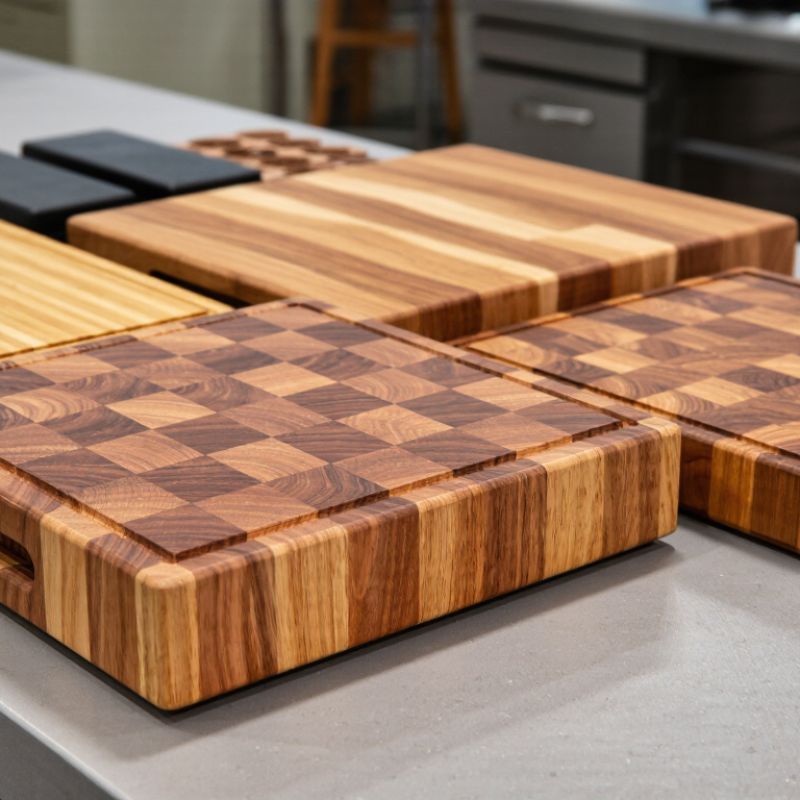
An end grain cutting board is made from short wood blocks with their cut ends facing upward. The wood fibers stand vertically, rather than running across the cutting surface. When a knife contacts the board, its edge slips between these fibers instead of cutting directly across them. This construction can reduce visible knife marks and offer a more forgiving surface for repeated food preparation.
The “self-healing” description needs careful explanation. Small cuts may close visually as the fibers move back slightly, but the board does not repair deep damage. It still requires drying, regular oiling, and proper storage. In practical inspections, wholesale buyers should check for a flat surface, tight joints, clean edges, and consistent block alignment. A board that rocks on a countertop may create safety concerns, even when its appearance seems attractive.
For wholesale purchasing, thickness matters. Boards around 35 to 50 millimeters often provide useful stability, but heavier products increase shipping costs. Buyers should also verify moisture control, food-contact finishing materials, packaging protection, and size tolerances. Wood species affect weight, color, hardness, and pricing. Some buyers focus only on appearance. That can be a costly mistake. Sample testing under repeated washing and drying may reveal joint gaps or warping that photographs cannot show.
Which Materials and Construction Features Matter Most?
2026 Best End Grain Cutting Board for Wholesale Buyers
For wholesale buyers, material choice starts with stability, not appearance. Hard maple offers a fine, tight grain and predictable machining. Beech is dense, practical, and often more cost controlled. Acacia can provide attractive color variation, but its movement may differ between batches. That variation is not always a defect. Still, suppliers should inspect moisture content before assembly. Wood that is too wet may shrink and open small joints later.
Construction quality matters more than a polished product photo. Look for end-grain blocks with tight, even joints and no visible voids. A board around 35 to 45 millimeters thick usually feels stable during repeated chopping. Food-safe adhesive and a penetrating finish help reduce moisture absorption. Avoid heavy surface coatings that can crack or peel under washing. Rounded edges improve handling, while rubber feet can prevent sliding on stainless-steel worktables. A juice groove is useful, but it also reduces cutting space and can trap residue if poorly finished.
For larger orders, ask for sample testing before approving production. Check flatness, corner strength, sanding quality, and odor after unpacking. Packaging should protect corners without trapping moisture. I would not rely on one inspection alone. Wood changes with climate. A small percentage of boards may need adjustment or replacement, even with careful control. That possibility should be included in the purchasing plan, not hidden. Reliable suppliers explain these limits and document their inspection process.
2026 Best End Grain Cutting Board for Wholesale Buyers - Which Materials and Construction Features Matter Most?
| Material |
Approx. Janka Hardness
(lbf) |
Typical Density
(kg/m³) |
Knife-Friendliness |
Moisture-Movement Risk |
Durability in End Grain |
Recommended Construction |
Wholesale-Buyer Considerations |
| Hard Maple |
1,450 |
630–705 |
Excellent |
Medium |
Very good |
Use kiln-dried blocks with alternating grain direction, tight glue joints, and a fully sanded end-grain surface. |
Consistent color, strong wear resistance, and broad market acceptance. Suitable for daily-use and professional-style boards. |
| Black Walnut |
1,010 |
550–610 |
Excellent |
Low to medium |
Good |
Select straight, defect-free blocks and use moderate clamping pressure to reduce joint stress and color variation. |
Lightweight for its size, naturally dark in color, and positioned well for premium assortments. Scratches may be more visible on dark surfaces. |
| Black Cherry |
950 |
560–610 |
Excellent |
Medium |
Good |
Use stable, well-conditioned blocks and a protective perimeter frame only when the frame is engineered to accommodate seasonal movement. |
Smooth cutting feel and warm color that deepens with age. Best suited to decorative, gift, and mid-to-premium product lines. |
| White Oak |
1,360 |
650–770 |
Very good |
Medium to high |
Very good |
Use carefully dried blocks, balanced layouts, and a generous edge radius to reduce splintering and impact damage. |
Dense and impact-resistant, but heavier than walnut or cherry. Open grain should be sanded thoroughly for a smooth food-contact surface. |
| Acacia |
1,100–1,750* |
600–800 |
Very good |
Medium to high |
Very good |
Verify the exact species, moisture content, and glue compatibility; use narrow, well-matched blocks to manage movement. |
Distinctive grain and strong hardness appeal. Species variation is significant, so incoming quality inspection is especially important. |
| Teak |
1,070 |
610–690 |
Very good |
Low to medium |
Excellent |
Use sharp tooling and a compatible adhesive because natural oils can interfere with bonding; seal end-grain pores thoroughly. |
Naturally dimensionally stable and moisture-resistant, but oily surfaces require careful finishing and adhesive preparation. |
| Rubberwood |
960 |
560–650 |
Good |
Medium to high |
Moderate |
Require kiln drying, preservative compliance, precise moisture control, and strong quality screening for cracks or weak joints. |
Uniform light color and competitive material efficiency. Product documentation should confirm food-contact finish and treatment status. |
| Bamboo End-Grain Composite |
Not directly comparable* |
650–800 |
Fair to good |
Medium |
Moderate |
Use formaldehyde-compliant, food-contact adhesive, accurately machined blocks, and rounded edges to reduce chipping. |
Renewable-material positioning and uniform appearance are attractive, but the hard surface can dull knives faster than softer hardwoods. |
Construction Features That Matter Most for Wholesale Purchasing
| Moisture Content |
Target approximately 6–8% for many indoor markets, while confirming the destination climate and manufacturing specifications. |
| Block Orientation |
The cutting surface should expose the ends of the wood fibers; consistent block orientation improves appearance and cutting performance. |
| Adhesive and Finish |
Specify a cured adhesive suitable for food-contact applications and a finish made from food-contact-compatible mineral oil or wax systems. |
| Board Thickness |
A thickness of approximately 35–50 mm offers a useful balance of stability, weight, perceived value, and shipping efficiency. |
| Edge Treatment |
Rounded corners and a small edge radius reduce chipping, improve handling comfort, and lower packaging-damage risk. |
| Quality Inspection |
Check flatness, open glue joints, end splits, stains, odor, roughness, finish uniformity, packaging integrity, and dimensional tolerance before shipment. |
*Janka hardness and density vary by species, growing conditions, moisture content, and test method. Bamboo is a grass-based composite rather than conventional solid wood, so direct hardness comparisons should be treated cautiously.
How to Evaluate Size, Durability, and Food Safety?
2026 Best End Grain Cutting Board for Wholesale Buyers
For wholesale buyers, size affects both productivity and shipping cost. A 18-by-24-inch board suits commercial prep stations, while smaller boards fit retail kitchens. Measure the usable surface, not only the outer frame. A board should remain stable when a cook applies pressure near its edge. End grain construction can reduce visible knife marks, but it still needs careful maintenance. Look for tight joints, level feet, and a moisture reading near 6–10% before shipment. This range helps reduce cracking in many indoor environments, though climate changes can prove me wrong.
Durability also depends on wood density, finish quality, and repair options. Avoid boards with deep glue gaps, rough corners, or strong chemical odors. Food safety deserves more attention than appearance. The FDA Food Code 2022 requires food-contact surfaces to be smooth, durable, and easily cleanable. USDA FSIS advises washing cutting boards with hot, soapy water after use and sanitizing them regularly. CDC estimates that foodborne illness causes about 48 million illnesses annually in the United States. A board cannot prevent contamination alone. Design still matters. Choose reversible surfaces, removable feet, and clear care instructions.
Tips: Request production samples before placing a large order. Test warping after washing. Check whether the finish remains intact after repeated cleaning. Ask for wood species, moisture-control procedures, and food-contact finish documentation. Do not trust “food-safe” as a complete claim. It needs evidence. A slightly heavier board may perform better, but shipping losses can erase that advantage.
What Should Wholesale Buyers Check Before Ordering?
2026 Best End Grain Cutting Board for Wholesale Buyers
For 2026 wholesale orders, the best end grain board is not simply the heaviest one. Check the wood species, moisture content, adhesive rating, and batch controls. A board may look perfect under showroom lights, then warp after a humid shipment. Request moisture readings, edge photographs, and a retained sample. The USDA Economic Research Service reported that food-away-from-home spending represented 58.5% of total U.S. food spending in 2023. The National Restaurant Association projected U.S. restaurant sales would reach $1 trillion in 2024. Repeatable hygiene and replacement planning matter more than dramatic grain patterns.
Check food-contact suitability before discussing price. The FDA Food Code 2022 requires food-contact surfaces to be smooth, durable, and easily cleanable. Wooden cutting surfaces are permitted in specified applications. Ask for a material declaration, adhesive specification, finish details, and cleaning instructions. Avoid vague claims like “food safe.” They are not test reports. Confirm finished dimensions, weight, tolerances, packaging protection, pallet limits, and carton-drop testing. Small errors become expensive when shelves and bundled sets must align.
For end grain construction, inspect block bonding, open joints, loose fibers, and rubber-foot compression. Ask how rejects are recorded, not only how many units ship. Order a pilot batch, wash samples repeatedly, and measure warping after 72 hours. That feels slow. It is cheaper than a container of returns. One limitation deserves honesty: wood performance varies with climate, care, and user habits. A supplier promising zero movement is overselling certainty. Choose traceable batches, clear tolerances, and a written remedy for defects.
How to Compare Suppliers, Pricing, and Customization Options?
For 2026 wholesale buying, compare suppliers by measurable specifications, not polished photographs. Request wood species, end-grain orientation, moisture content, dimensions, and tolerance ranges. The USDA Forest Products Laboratory Wood Handbook, FPL-GTR-282, explains that wood moisture changes with surrounding humidity. Ask suppliers to target stable indoor moisture levels, usually near 6–8%. A warped board creates returns.
Pricing needs a complete cost model. Compare the board price, packaging, inspection, tooling, freight, and replacement policy. Request quotes for 100, 500, and 1,000 units. This reveals whether volume discounts are real. A 40 × 30 × 4 cm board may use more timber than expected because end-grain assembly creates cutting waste. Cheap is not always efficient. Review payment terms carefully.
Customization should be tested with a physical sample. Check logo depth, corner radius, juice groove accuracy, rubber feet, handle design, and carton strength. Ask for a pre-production sample before approving mass production. The FAO Global Forest Resources Assessment 2020 reports that forests cover about 31% of global land, making responsible wood sourcing a practical procurement issue. Suppliers should provide species origin and traceability documents. Some buyers overlook packaging damage during price comparisons. That is a mistake. A better evaluation sheet records defect rates, lead times, sample approval dates, and communication response time. Yet even this method is imperfect; seasonal timber movement can still change results.
2026 Best End Grain Cutting Board for Wholesale Buyers
How to compare suppliers, pricing, and customization options
This buyer scorecard uses a 100-point procurement model: landed price accounts for 35 points, end-grain construction quality for 25, food-contact compliance for 15, customization capability for 15, and lead-time reliability for 10. A higher score indicates a stronger overall wholesale option.
FAQS
Hard maple offers tight grain and predictable machining. Beech is dense and often more cost controlled. Acacia provides varied color, but batch movement may differ. Appearance alone is not enough.
Look for tight end-grain joints without visible gaps or voids. A thickness of 35–45 millimeters usually feels stable. Rounded edges improve handling. Rubber feet can reduce sliding on metal worktables.
Many indoor environments suit moisture readings near 6–10%. Suppliers should measure every production batch. This range helps, but it is not magical. Climate changes can still cause movement.
Request physical samples before approving mass production. Test flatness, corner strength, sanding quality, and surface stability after washing. Check whether feet remain level. Samples matter.
Smooth, durable surfaces are easier to wash and maintain. Reversible faces can extend usable life. Removable feet help cleaning around the underside. Deep grooves may trap residue if poorly finished.
A juice groove can collect liquid during food preparation. It also reduces cutting space. Poor finishing may leave rough edges or trapped residue. Useful, sometimes.
Include board price, packaging, inspection, tooling, freight, and replacement costs. Request prices for 100, 500, and 1,000 units. Cheap is risky. A low unit price may hide high shipping losses.
Ask for samples showing logo depth, corner radius, groove accuracy, feet, handles, and carton strength. Request wood species, origin, traceability, moisture procedures, and finish documentation. Even careful checks can miss seasonal timber movement.
Conclusion
This guide explains what makes an End Grain Cutting Board a practical choice for wholesale buyers. Unlike edge-grain or face-grain boards, its wood fibers are oriented vertically, helping absorb knife impact, reduce visible cut marks, and support long-term durability. The article reviews important material and construction factors, including responsibly selected hardwood, stable moisture levels, secure joints, smooth finishing, and food-safe treatments. It also shows how to evaluate board dimensions, weight, thickness, edge comfort, surface quality, and resistance to warping or cracking.
For wholesale purchasing, buyers should confirm product consistency, safety documentation, packaging standards, minimum order quantities, production capacity, lead times, and quality-control procedures. The guide also explains how to compare supplier quotations by considering material grade, workmanship, shipping costs, replacement policies, and total order value rather than price alone. Finally, it discusses customization options such as sizes, shapes, engraving, packaging, and private labeling, helping buyers select a reliable supply plan that matches their market, budget, and expected customer use.