

FSC
Certified
Food
Grade
ISO
Quality
0%

Choosing the right Wooden Kitchen Utensils Set involves more than matching a countertop or selecting a low price. Wood type, construction quality, hygiene, comfort, and long-term durability all matter. A spoon may feel smooth in a showroom, yet develop rough edges after repeated washing. Small details matter.

Industry research supports this practical approach. The National Kitchen & Bath Association’s 2024 Design Trends Report highlights demand for functional storage, natural materials, and durable kitchen solutions. Grand View Research’s kitchen utensils market analysis also identifies growing consumer interest in sustainable and reusable products. These reports suggest a clear direction: buyers increasingly want tools that look attractive and perform reliably.

Safety should guide every comparison. The U.S. Food and Drug Administration’s 2022 Food Code emphasizes cleanable, durable, and non-absorbent food-contact surfaces. Wooden utensils require careful drying because trapped moisture may encourage odor and surface deterioration. The United States Department of Agriculture also recommends cleaning kitchen tools thoroughly after food preparation. Simple habits help. Wash gently. Dry completely.

This guide examines bamboo, beech, acacia, and other common materials. It compares handle comfort, grain quality, finish, utensil thickness, and storage design. It also considers whether a set includes genuinely useful pieces or unnecessary duplicates. A low price can be attractive, but replacement costs may tell another story. No set is perfect. Even well-made wood can stain, crack, or need occasional conditioning. The best Wooden Kitchen Utensils Set should fit your cooking habits, maintenance routine, and realistic expectations.
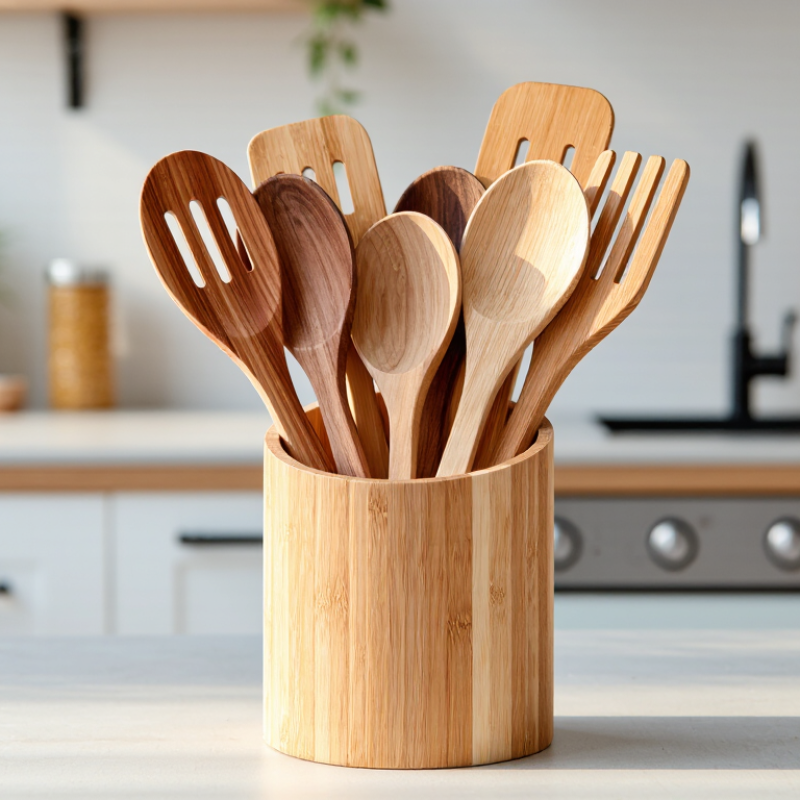
How to Choose the Best Wooden Kitchen Utensils Set?

Define Your Cooking Needs and Preferred Utensil Types

Choosing the best wooden kitchen utensil set starts with your cooking routine, not the number of pieces. The U.S. Bureau of Labor Statistics’ 2023 American Time Use Survey reported that Americans spent about 37 minutes daily preparing food and cleaning up. That time adds up. If you cook soups often, choose a deep ladle and a long-handled spoon. For stir-fries, use a broad spatula and sturdy tongs. Bakers may need a flat scraper and a narrow spoon.

Think about your cookware, too. A wooden edge is gentle on coated pans, but it cannot replace every tool. The FDA Food Code 2022 emphasizes that food-contact surfaces should be smooth, durable, and easy to clean. Avoid rough grain, deep cracks, or loose handles. I once chose a beautiful set with several similar spoons. It looked complete, but two pieces stayed unused. That was wasteful. A smaller set may fit your real habits better.

Tips: Write down three meals you cook weekly. Match each meal to one utensil. Check the grip with wet hands. Look for sealed, smooth wood. Wash utensils promptly and dry them upright. Do not leave them soaking overnight. USDA Food Safety and Inspection Service guidance supports cleaning food-contact tools after use. Wood also needs honest inspection. If the surface becomes deeply split, replace it. A perfect set on paper may still feel awkward in your kitchen.

Compare Wood Types for Strength, Safety, and Durability

How to Choose the Best Wooden Kitchen Utensils Set?

Wood type affects strength, safety, and daily durability. In my kitchen, hard maple has handled hot pans, thick sauces, and repeated stirring without serious dents. It has a tight grain, so it absorbs less moisture than many softer woods. Beech is another reliable choice. It feels firm, remains affordable, and usually resists splitting when properly dried. Both woods are suitable for spoons, spatulas, and turners.

Teak contains natural oils that help it tolerate moisture, but those oils can make the surface feel slightly greasy. It is durable, though some cooks dislike that texture. Walnut is attractive and comfortable to hold, yet it is softer than maple and may show knife marks sooner. Bamboo is lightweight and often strong for its weight. However, many bamboo utensils are laminated, so poor bonding can lead to separation after repeated soaking. That detail is easy to miss.

Look closely at the grain and joints. Avoid pieces with deep cracks, rough splinters, or strong chemical odors. A smooth, unfinished surface is not automatically safer; it may absorb cooking oils and water quickly. Choose utensils treated with a food-safe finish, and wash them by hand. Dry them upright or on a rack, not in a damp drawer. Even good wood can warp. I once left a spoon soaking overnight, and it developed a small split. That mistake changed my routine. Replace any utensil that becomes deeply cracked, because cleaning the interior is difficult.

How to Choose the Best Wooden Kitchen Utensils Set? - Compare Wood Types for Strength, Safety, and Durability

A practical comparison of common materials used for spoons, spatulas, turners, forks, and cooking sets.

Material Approx. Hardness Strength & Durability Safety & Food Contact Advantages Limitations Best For
Hard Maple About 1,450 lbf on the Janka scale Very hard, stable, and resistant to dents and abrasion. Suitable for frequent daily use. Generally suitable when unfinished or treated with a food-contact-safe finish. Its relatively closed grain is easy to clean. Excellent balance of strength, smooth texture, neutral appearance, and long service life. Can be more expensive than softer woods; prolonged soaking may still cause swelling or cracking. Heavy-use spatulas, turners, spoons, and general-purpose sets.
Beech About 1,300 lbf on the Janka scale Hard and resilient with good shock resistance. Performs well under regular kitchen use. Fine, fairly uniform grain makes it easy to wash and inspect. Use only a suitable food-contact-safe finish. Smooth feel, dependable strength, good value, and easy shaping. May darken with age and can be vulnerable to moisture if left wet or stored in a damp area. Balanced utensil sets for everyday cooking and baking.
Walnut About 1,010 lbf on the Janka scale Moderately hard and dimensionally stable. Less resistant to deep scratches than maple or beech. Safe for food contact when properly manufactured and finished. Its open grain requires thorough cleaning and drying. Lightweight, comfortable to hold, attractive dark color, and relatively stable with temperature changes. Softer and typically more costly; dark color may show flour, oil, or light scratches. Serving spoons, salad utensils, and premium-looking low-impact tools.
Acacia Typically about 1,100–1,750 lbf; species vary widely Often dense and wear-resistant, but performance depends strongly on the particular acacia species and construction. Suitable for food contact when free from harmful coatings and properly finished. Inspect for cracks along contrasting grain. Good toughness, attractive natural variation, and strong resistance to everyday wear. Quality and hardness can vary considerably; rough grain or poor drying may increase splitting risk. Decorative yet durable spoons, servers, and mixed utensil sets.
Teak About 1,070 lbf on the Janka scale Moderately hard with natural dimensional stability and good moisture resistance. Not as dent-resistant as hard maple. Use only products intended for food contact; naturally occurring oils may affect coating adhesion and surface feel. Handles humidity relatively well and has a warm appearance and smooth feel. Can be oily, relatively expensive, and less common in finely edged utensils. Moisture-prone kitchens, serving tools, and durable specialty utensils.
Bamboo Varies by species and processing; not directly comparable to solid wood Lightweight and reasonably stiff. Laminated bamboo can be durable, but seams may separate after repeated soaking or dishwasher cycles. Choose smooth, splinter-free products made with adhesives and finishes suitable for food contact. Light, renewable, widely available, and usually economical. May feel less substantial; lower-quality laminated pieces can crack, delaminate, or develop rough edges. Lightweight everyday sets, measuring tools, and occasional-use utensils.

Buying guidance: For the best overall combination of strength, safety, and durability, choose hard maple or beech. Select walnut for lighter handling and appearance, acacia for varied natural character, teak for moisture-prone environments, and bamboo for a lightweight budget-friendly option.

Care note: Hand-wash wooden utensils with mild soap, dry them promptly, avoid prolonged soaking and harsh dishwasher cycles, and periodically apply a suitable food-contact-safe conditioning oil according to the manufacturer’s instructions. Janka hardness values are approximate and can vary by species, growing conditions, moisture content, and testing method.

Evaluate Utensil Design, Size, Comfort, and Practical Features

How to Choose the Best Wooden Kitchen Utensils Set?

A useful wooden utensil set starts with design, not decoration. Choose a rounded spatula edge for scraping pans without sharp pressure points. A narrow spoon reaches small saucepans more effectively. A slotted turner helps drain oil and liquids. Grand View Research estimated the global kitchen utensils market at approximately USD 2.2 billion in 2023, with steady growth expected through 2030. That growth makes attractive sets common, but appearance alone proves little.

Size should match your cookware and hand strength. A 28–32 centimetre handle usually keeps fingers away from hot surfaces. However, an oversized handle may feel awkward in a small saucepan. Look for a smooth grip with a moderate diameter and balanced weight. Test the utensil in your hand, if possible. It should not twist when stirring thick soup. I once chose a broad spoon because it looked durable. It was tiring after ten minutes.

Practical features deserve careful inspection. Select dense, smoothly finished wood without splits, rough pores, or loose joints. The FDA Food Code emphasizes smooth, easily cleanable food-contact surfaces. WHO also reports that contaminated food causes about 600 million illnesses worldwide each year, reinforcing careful utensil hygiene. Wash wooden tools promptly, dry them upright, and inspect them regularly. A hanging hole saves drawer space, but it can trap moisture if poorly finished. That detail is easy to miss. A dishwasher-safe claim may sound convenient, yet repeated heat and water can shorten wooden utensils’ service life. Reconsider convenience.

Check Craftsmanship, Food Safety, Maintenance, and Sustainability

How to Choose the Best Wooden Kitchen Utensils Set?

Good craftsmanship starts with the grain. Choose utensils with smooth edges, balanced handles, and no visible cracks. Look closely. Dense woods, such as maple or beech, often resist splintering during daily cooking. However, hardness alone does not prove quality. Check whether the spoon feels comfortable after several minutes of stirring. A well-made set should not wobble, smell strongly of chemicals, or show rough patches around carved areas. I once bought an attractive set with uneven edges. It looked fine online, but constant sanding became irritating.

Food safety depends on both materials and habits. Select utensils finished with a clearly identified, food-safe coating. Avoid products with peeling varnish or unknown surface treatments. After preparing food, wash wooden tools with warm water and mild soap. Do not soak them overnight. Dry them upright, away from trapped moisture. A dishwasher can cause warping and splits. For deeper care, apply a thin layer of food-grade mineral oil when the wood appears dry. Cooking oils may become rancid.

Sustainability requires more than a natural appearance. Look for responsibly sourced wood and useful information about its origin. Durable construction matters because replacement creates more waste. A smaller set may be better than ten rarely used tools. Still, certification labels can be difficult to interpret, and packaging claims are not always complete. Ask practical questions. Can the utensil be repaired? Will it last through years of ordinary washing? These details reveal more than attractive photographs.

How to Choose the Best Wooden Kitchen Utensils Set?

Recommended assessment weighting for craftsmanship, food safety, maintenance, and sustainability

When comparing wooden kitchen utensil sets, give the greatest attention to construction quality and food-contact safety. Look for smooth surfaces, secure joints, food-safe finishes, and wood that is free from cracks or splinters. Maintenance and sustainability are also important: utensils should be easy to hand-wash and dry, while responsibly sourced, durable wood can reduce replacement frequency. These percentages are a practical evaluation framework rather than laboratory test results.

Choose the Best Set Based on Quality, Value, and Kitchen Use

How to Choose the Best Wooden Kitchen Utensils Set?

Quality starts with the wood, not the number of pieces. Look for dense, straight-grained hardwood with a smooth, splinter-free surface. Run your fingers along every edge and inspect the spoon bowls for cracks. A well-made utensil feels balanced, even when your hand is wet. Avoid handles with rough joints or deep gaps, where food and moisture can collect. A food-safe finish should feel satin-smooth, never sticky or heavily coated.

In my own kitchen, I once chose attractive utensils with thin handles. They warped after repeated washing. That was poor judgment.

Value depends on useful coverage, not a crowded box. A practical set may include a slotted spoon, solid spoon, turner, fork, and spatula. Choose shapes that match your cooking habits. A wide turner helps with pancakes, while a narrow spoon suits small saucepans.

If you rarely stir soup, three dependable tools may offer better value than ten similar pieces. Check whether each item can be replaced individually. This matters when one utensil eventually wears out.

Kitchen use should guide size, weight, and maintenance.

Long handles protect hands from hot steam, but oversized tools can feel awkward in a small pan. Keep wooden utensils away from soaking water and dry them upright after washing. Never treat them like disposable plastic. Applying a small amount of suitable mineral oil can reduce dryness, although excessive oil may leave a greasy surface. Even careful users miss this sometimes. Inspect the grain monthly for raised fibers, splitting, or dark moisture marks. Wash those tools promptly and reconsider their storage spot.

FAQS

How should I choose a wooden utensil set for my cooking habits?

List three meals you cook each week. Match each meal with one useful utensil. A smaller set may suit you better.

Which utensils are useful for soups and stir-fries?

Choose a deep ladle and long-handled spoon for soups. Stir-fries need a broad spatula and sturdy tongs. Bakers may prefer a scraper.

What wood quality should I look for?

Choose dense, straight-grained hardwood with smooth, splinter-free surfaces. Avoid deep cracks, rough pores, loose joints, and sticky finishes.

How can I check whether a utensil feels comfortable?

Hold it with wet hands, if possible. The handle should feel balanced and should not twist while stirring thick soup. Comfort matters.

What utensil sizes work well in most kitchens?

Handles around 28–32 centimetres can keep hands away from heat. Oversized tools may feel clumsy in small saucepans.

How many pieces provide good value?

Useful coverage matters more than a crowded box. A solid spoon, slotted spoon, turner, fork, and spatula may be enough. Ten similar pieces can become drawer clutter.

How should wooden utensils be washed and stored?

Wash them promptly after use and dry them upright. Do not soak them overnight. A hanging hole saves space, but it may trap moisture.

Can wooden utensils go into a dishwasher?

Repeated heat and water may shorten their service life. Hand washing is usually gentler. I once chose convenience and regretted it.

When should a wooden utensil be replaced?

Inspect the grain monthly for splitting, raised fibers, and dark moisture marks. Replace tools with deep splits or stubborn damage. Do not ignore small warning signs.

Does mineral oil help maintain wooden utensils?

A small amount of suitable mineral oil may reduce dryness. Use very little. Too much can leave a greasy surface, and I sometimes overdid it.

Conclusion

Choosing the best Wooden Kitchen Utensils Set starts with understanding your cooking habits and selecting tools that match your daily needs, such as spoons, spatulas, forks, or tongs. Consider different wood types for their strength, safety, moisture resistance, and long-term durability. A well-designed set should offer comfortable handles, practical sizes, smooth edges, balanced weight, and shapes that work effectively with various cookware.

It is also important to examine the craftsmanship, including polished surfaces, secure construction, and food-safe materials. Easy maintenance, proper drying, and responsible sourcing can help extend the utensils’ lifespan while supporting a more sustainable kitchen. By comparing quality, functionality, care requirements, and overall value, you can choose a Wooden Kitchen Utensils Set that is comfortable to use, safe for food preparation, suitable for your cooking style, and dependable for everyday kitchen tasks.

Olivia

Olivia

Olivia is a professional marketing specialist with a strong understanding of modern business strategy, customer needs, and digital communication. As a dedicated member of our team, she combines market insight with product expertise to create clear, useful, and engaging content for our company......