


Expert knowledge on Acacia, Teak, and Rubberwood kitchenware manufacturing, sustainable sourcing, and export trends.
Learn how NaTree ensures full compliance with global food safety regulations and eco-friendly timber standards.
Choosing the right Wooden Coaster Set is not only about finding attractive wood grain. It is about protecting your table, simplifying daily care, and matching the set to your home. A coaster may look small, yet its finish, thickness, and edge design affect every use. A thin coaster can slide easily. Rough surfaces may scratch polished furniture. Poor sealing can leave dark rings after one iced drink.
Woodworking educator Paul Sellers offers a useful principle: “The work is the teacher.” That idea applies when judging a Wooden Coaster Set. Look closely at the sanding, corners, joinery, and protective coating. Run your fingers across the surface. Check whether the coaster sits flat on a glass table. These small tests reveal more than attractive product photographs. They also encourage buyers to think beyond decoration.
This guide explores seven practical tips for buying a better set. You will consider wood type, moisture resistance, size, thickness, stability, maintenance, and value. Some choices are subjective. A rustic finish may charm one buyer and disappoint another. I have also learned that “water-resistant” does not mean maintenance-free. That distinction is easy to overlook.
Think about your actual routine. Do you use steaming mugs, cold bottles, or wide wine glasses? Do you need cork backing for delicate surfaces? The best Wooden Coaster Set should fit those habits naturally. It should feel dependable in your hand and quiet on the table. Beauty matters, but performance decides whether the set earns a permanent place in your home.
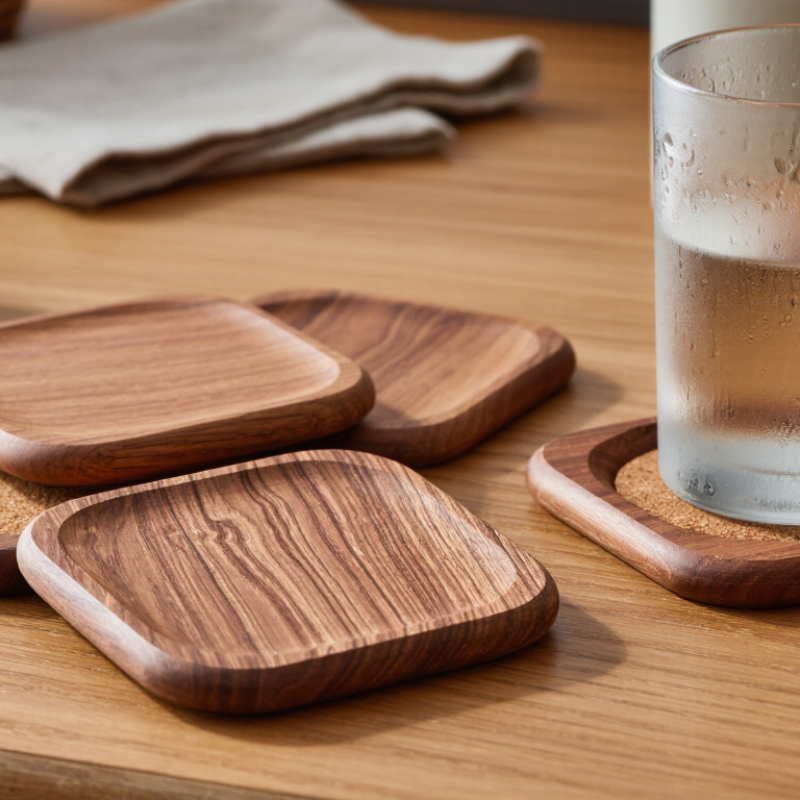
7 Tips for Buying the Best Wooden Coaster Set
Define Coaster Size and Shape: Common diameters range from 9–10 cm. This size suits many mugs, cups, and narrow tumblers. A 9 cm coaster measures about 3.5 inches across. Leave at least 0.5 cm beyond the vessel’s base. That small edge catches drips more effectively. Measure the actual base, not the widest rim. A wide glass may need an 11 cm coaster.
IMARC Group’s 2024 tableware market analysis valued the global market at approximately US$47 billion in 2023. Its findings highlight durability, design, and household practicality as important buying factors. For wooden coasters, thickness matters too. A 6–10 mm profile feels stable without raising a glass awkwardly. Round shapes work well for daily cups. Square or hexagonal designs offer more corner coverage, but may occupy more table space.
Tip: Test the base first. Place your largest everyday glass on the coaster. Check whether it stays centered after a gentle table movement. Choose sealed wood with a smooth underside to reduce moisture absorption and scratches. Cork or rubber feet can improve grip, although they may collect dust. I would not assume a larger coaster is always better. It can look oversized, and my own sizing judgment has occasionally been too generous. A practical set should fit real drinkware, not only look attractive in photographs.
Common wooden coaster diameters range from 9–10 cm. Larger coasters provide more clearance around standard mugs and glasses, while smaller sizes offer a compact fit.
When buying the best wooden coaster set, inspect the wood species and its moisture level. Moisture matters more than many shoppers expect. A coaster can look smooth today, then warp beside a sunny window.
Hardwoods such as maple, beech, and oak usually provide good strength for daily use. Each species behaves differently, however. Oak has visible pores, while maple often offers a tighter surface. These differences affect water absorption, texture, and finishing results. For indoor wooden products, a moisture reading near 6–8% is generally a sensible target in climate-controlled homes. Local humidity can change that range.
Ask how the moisture was checked. A calibrated moisture meter gives more useful evidence than a confident appearance. Test several coasters, including their centers and edges. Readings may shift after storage or shipping. Leave the set unboxed for at least 48 hours before judging its shape.
This is not a laboratory test. I have seen attractive pieces develop slight cupping after moving from a dry showroom into a humid kitchen.
Look for straight surfaces, smooth edges, and no open cracks around the grain. A protective finish should resist ordinary condensation, but it should not feel thick or sticky. Cork or silicone feet can reduce contact with wet tables. Still, they may trap moisture underneath. Lift the coasters occasionally and let both surfaces breathe. No wood is completely maintenance-free.
7 Tips for Buying the Best Wooden Coaster Set
Tip 1: Inspect the finish under bright, angled light. A reliable coating should look even, without bubbles, pinholes, cloudy patches, or exposed wood. Tip 2: Run a dry fingertip across the surface. It should feel smooth, not sticky or gritty. Tip 3: Check every edge. Uneven coating often collects moisture there.
Tip 4: Ask how the finish relates to FDA 21 CFR 175.300. This regulation covers certain resinous and polymeric coatings used in food-contact applications. A seller should provide specific compliance information, not simply say “food safe.” Tip 5: Request documentation showing the coating’s intended use, curing conditions, and temperature limits. Those details matter when a cold, wet glass sits on the coaster for hours. Compliance is not a universal guarantee. It depends on the coating, use conditions, and finished product.
Tip 6: Smell the set briefly after opening it. A strong chemical odor deserves caution, although odor alone does not prove a coating is unsafe. Tip 7: Test one coaster with a few drops of water. Look for whitening, tackiness, swelling, or color transfer after several minutes. I would also inspect the underside, where manufacturers may apply less finish. This step is easy to overlook. Wooden grain can be beautiful, but visible grain does not confirm proper protection. Keep the seller’s specifications and batch information when available; they make later questions easier.
| Tip | Buying Dimension | What to Evaluate | Practical Inspection Method | Preferred Buying Benchmark | Useful Evidence to Request |
|---|---|---|---|---|---|
| 1 | Confirm the coating’s intended use | FDA 21 CFR 175.300 applies to resinous and polymeric coatings intended for repeated food-contact use when the coating meets the regulation’s compositional and extractive-limit conditions. | Ask whether the finish is intended for incidental contact with food or beverages and whether the supplier has assessed the actual use conditions, including temperature, contact time, and food type. | A clear statement of intended food-contact use, rather than a general claim such as “non-toxic” or “food-safe.” | Written compliance statement identifying 21 CFR 175.300 and the tested or assessed conditions of use. |
| 2 | Inspect surface uniformity | The finished surface should be continuous and suitable for its intended use. Cracks, pinholes, flaking, and exposed wood can compromise cleanability and coating performance. | View the coaster under bright angled light. Run a clean fingertip over the surface and inspect the rim, underside, engraved areas, and coaster-to-coaster consistency. | No visible peeling, bubbling, open pores, sharp coating ridges, sticky areas, or exposed unfinished sections on the beverage-contact surface. | Representative production sample or clear close-up photographs of the top, edges, and underside. |
| 3 | Evaluate moisture resistance | Wood naturally absorbs moisture. A suitable finish should reduce water penetration during normal use, while the compliance assessment must still reflect the coating’s intended contact conditions. | Place a few drops of room-temperature water on the finished surface for approximately 15 minutes, then wipe dry and inspect for whitening, swelling, raised grain, or dark rings. | No visible whitening, tackiness, raised grain, edge swelling, or permanent water mark after the test. | Supplier moisture-resistance test method and results using a coating system representative of production. |
| 4 | Check hot-drink performance | A coating should be evaluated for the expected temperature range. FDA 21 CFR 175.300 compliance is condition-specific; a coating suitable for room-temperature use is not automatically suitable for hot applications. | Use a heat-resistant sample test with a warm mug or cup consistent with the intended product use. Inspect after cooling for softening, ring marks, cracking, or odor. | The surface remains hard, level, odor-free, and free of visible damage under the product’s stated temperature range. | Temperature-resistance data and a clearly stated maximum recommended use temperature. |
| 5 | Assess cleanability and finish stability | The surface should tolerate ordinary cleaning without losing its protective layer. Avoid treating “washable” as equivalent to dishwasher-safe unless that use has been specifically tested. | Wipe the coaster repeatedly with a clean damp cloth and a mild detergent solution, then check for clouding, color transfer, tackiness, or loss of gloss. | No coating transfer, sticky residue, visible clouding, cracking, or discoloration after repeated wiping cycles. | Cleaning-cycle test details, including detergent type, number of cycles, drying method, and inspection results. |
| 6 | Review extractives and formulation documentation | 21 CFR 175.300 includes compositional provisions and limits on extractable substances for specified food-contact coating applications. The relevant limits depend on the regulation and conditions of use. | Request documentation for the exact coating formulation or coating system used on the coasters, not merely a certificate for a different product or a raw material. | Documentation links the tested coating, substrate, curing process, and intended conditions of use to the purchased coaster set. | Supplier declaration, extractives test report where applicable, coating technical data sheet, and curing instructions. |
| 7 | Verify curing, odor, and edge protection | A coating must be properly applied and cured to perform as intended. Persistent solvent odor, uncured tackiness, or unsealed edges can indicate an unsuitable or incomplete finish. | Smell the product after normal ventilation, press a clean white cloth on the surface, and inspect all edges and engraved details for tackiness or coating gaps. | No persistent strong chemical odor, no color or residue transfer, and consistent sealing across faces, edges, and recessed details. | Cure schedule, application thickness or process information, production inspection records, and batch traceability. |
| Important: FDA 21 CFR 175.300 is a U.S. food-contact coating regulation, not a universal “FDA-approved product” label. Compliance depends on the coating composition, application, curing process, substrate, food type, temperature, and duration of contact. A wooden coaster should not be marketed as suitable for direct food contact unless the complete finished article and its intended conditions of use have been properly evaluated. | |||||
Water resistance deserves more than a quick splash test. ASTM D1037 evaluates wood-based materials through conditioning, water exposure, absorption, and thickness swelling measurements. It is not written specifically for household coasters, but its principles provide a useful buying framework. Check whether the set has sealed faces, edges, and undersides. Unsealed edges often reveal weak protection first.
The USDA Forest Products Laboratory’s Wood Handbook reports average shrinkage of about 8% tangentially and 4% radially from green to oven-dry wood. Small coasters may still cup, crack, or loosen after repeated wetting. Look for straight surfaces and tight joints. Place a cold glass on one coaster for several minutes, then inspect for dark rings or raised grain. A seller’s water-resistance claim should ideally include absorption or swelling data, not vague words like “durable.” ASTM D1037 also emphasizes controlled conditioning, so results from casual droplets are only preliminary.
Consider coaster thickness, drainage grooves, and a washable finish. Cork or silicone feet can reduce trapped moisture beneath the wood. Avoid sets with rough edges, visible end-grain splits, or a strong chemical odor. I would not treat a glossy coating as permanent protection; heat, washing, and abrasion gradually expose the wood. That judgment can be imperfect. Wood species, finish quality, and indoor humidity all change performance. USDA guidance commonly places indoor wood moisture near 6–8% under moderate conditions, making storage and room climate relevant. Ask for test details, and buy one set before purchasing several.
Look for a clear FSC certification claim and a traceable certification code. FSC status supports responsible forestry, but it does not guarantee perfect craftsmanship. Verify the code through an official certification database. Check the wood species and origin, since vague descriptions reduce confidence. A reliable seller should answer both questions directly. Silence is a warning sign.
Run your fingers across every edge. Good craftsmanship feels smooth, without splinters, sharp corners, or uneven sanding. Inspect the grain, joints, and underside for cracks or rushed finishing. A protective coating should resist ordinary spills without feeling sticky. Test one coaster with a few drops of water first. Avoid soaking it. Thickness also matters, especially for heavy mugs and hot cups. Cork or silicone feet can protect tables, but poorly attached feet may detach quickly.
Compare the number of coasters with the actual price. A larger set is not better if several pieces feel thin or identical in poor quality. Look for consistent sizing, stable bases, and clear care instructions. I once bought an attractive set with beautiful grain, but its finish marked easily under a cold glass. That mistake changed how I judge durability. Consider replacement cost, packaging, and daily use rather than appearance alone. Even certified wood can disappoint when finishing and quality control are weak.
View it under bright, angled light. Look for bubbles, pinholes, cloudy areas, or exposed wood. Run a dry fingertip across it. It should feel smooth, not sticky or gritty.
Ask how the coating relates to FDA 21 CFR 175.300. Request intended use, curing conditions, and temperature limits. “Food safe” alone is too vague.
No. Compliance depends on the coating, finished product, and use conditions. A cold, wet glass may remain for hours. Details matter.
Place a few water drops on one coaster. Wait several minutes. Check for whitening, tackiness, swelling, dark rings, or color transfer. This is only a preliminary check.
Edges and undersides may receive less finish. Moisture often enters there first. Check for rough grain, cracks, swelling, and uneven coating.
Controlled conditioning, water exposure, absorption, and swelling measurements provide useful guidance. Casual splash tests are limited. Wood can cup, crack, or loosen after repeated wetting.
Look for smooth edges, stable bases, tight joints, and consistent sizing. Avoid splinters, sharp corners, end-grain splits, and rushed sanding. Small defects matter.
No. Check for a traceable certification code and clear wood origin. Certification supports responsible sourcing, but it does not guarantee strong finishing or durability.
Compare quantity, thickness, finish quality, replacement cost, packaging, and daily use. A larger set is not automatically better. I once trusted attractive grain too much.
Avoid soaking, excessive heat, and harsh washing. Keep the set in a moderate indoor environment. Wood moisture and humidity affect performance. My judgment may still be imperfect.
Choosing the best Wooden Coaster Set requires more than comparing appearance and price. Start by checking the coaster’s size and shape; common diameters of 9–10 cm offer a practical balance for cups, mugs, and glasses. The wood species also matters, as different types vary in grain, hardness, and stability. For indoor wooden products, a moisture level of approximately 6–8% can help reduce warping, cracking, and other problems caused by environmental changes.
Next, inspect the surface finish for smoothness, even coverage, and suitability for food-contact-related use, with coatings evaluated according to the principles of FDA 21 CFR 175.300. Water resistance can be compared through testing principles associated with ASTM D1037, focusing on swelling, staining, and surface damage. Finally, consider FSC certification when responsible sourcing is important, along with craftsmanship, edge quality, durability, and the overall value offered by the set. A well-made option should combine reliable protection, attractive design, and long-term everyday usability.