
Precision-milled from sustainable Acacia, Teak, and Rubberwood with custom branding, dimensional sizing, and food-safe oil treatments.
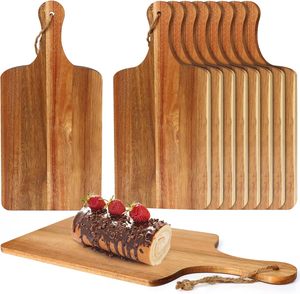
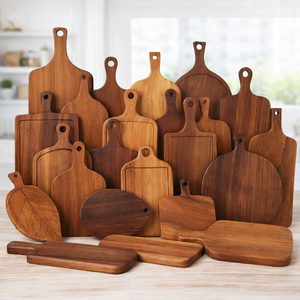
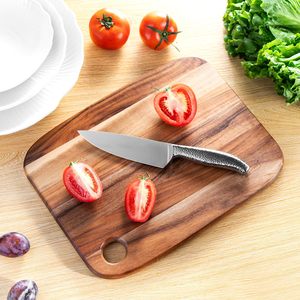
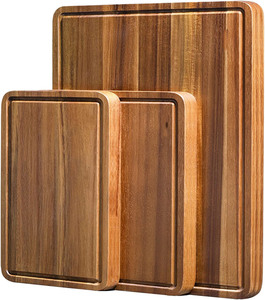
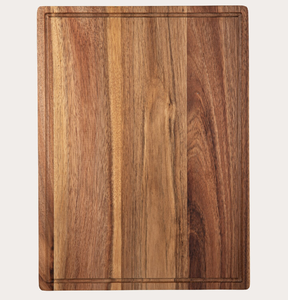
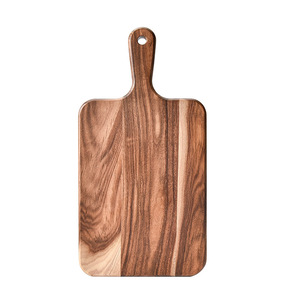
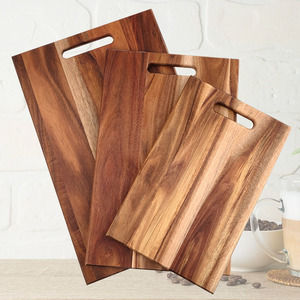
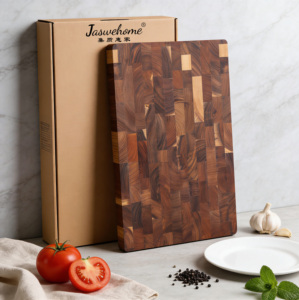
In the global commercial kitchenware market, sourcing heavy-duty chopping boards requires a rigorous evaluation of material physics, structural integrity, moisture stability, and international food contact compliance. Unlike mass-market retail cutting boards, commercial-grade butcher blocks and heavy-duty chopping boards must endure continuous high-impact cleaver strikes, aggressive chef knife work, and rapid sanitization cycles without warping, splitting, or harboring bacterial pathogens.
As global procurement teams shift away from microplastic-generating synthetic boards, high-density natural wood species—specifically Acacia (Acacia mangium / Acacia auriculiformis), Teak (Tectona grandis), and Rubberwood (Hevea brasiliensis)—have established dominance. Enterprise buyers must navigate complex OEM choices spanning grain orientation, waterproof food-safe adhesives, Equilibrium Moisture Content (EMC) kilning, and regulatory mandates such as the EU Deforestation Regulation (EUDR) and US FDA food contact directives.
Selecting the ideal wood species for heavy-duty chopping board manufacturing hinges on balancing surface hardness against knife edge retention. Wood that is excessively hard (such as high-density bamboo or synthetic composites) dulls forged culinary blades rapidly. Conversely, timber that is too soft scars easily, creating deep fissures where bacterial colonies thrive.
| Wood Species | Janka Hardness (lbf) | Specific Gravity | Warp & Humidity Resistance | Knife Edge Preservation | Primary Commercial Application |
|---|---|---|---|---|---|
| Thai Acacia Wood | 1,750 lbf | 0.68 - 0.75 | Exceptional (High natural oils) | Optimal (Absorbs force) | Heavy Butchery, End-Grain Blocks |
| Teak Wood | 1,070 lbf | 0.55 - 0.65 | Maximum (Rich in Silica/Tectoquionone) | Superior | Luxury Hospitality, Serving Platters |
| Rubberwood | 960 lbf | 0.58 | Moderate (Requires proper sealing) | Excellent | High-Volume Prep Boards, Bakery Blocks |
| North American Hard Maple | 1,450 lbf | 0.63 | Moderate (Susceptible to moisture warp) | Very Good | Traditional Countertop Blocks |
| European Beech | 1,300 lbf | 0.64 | Low (High volumetric shrinkage) | Good | Standard Culinary Prep Boards |
The mechanical performance of an OEM heavy-duty chopping board is largely dictated by its grain orientation. Factory buyers must specify the appropriate construction methodology based on target end-use cases:
Constructed by bonding vertically oriented wood segments. Knife blades cut between standing wood fibers rather than severing them. Offers self-healing capabilities, maximum durability under heavy cleaver strikes, and superior knife-edge longevity. Highly recommended for commercial butcher blocks.
Assembled using parallel horizontal wood strips. Delivers structural stability against flexural stress at a lighter overall weight. Ideal for large-format prep boards, handle-equipped chopping blocks, and dual-purpose serving boards in restaurant environments.
Engineered multi-layered core construction pairing dense Acacia outer layers with dimensional core stabilization. Designed specifically for extreme climate stability during long-haul container shipments across varying oceanic thermal zones.
The primary point of failure for imported wooden kitchenware is joint delamination or warping caused by uncalibrated moisture content. At NaTree (K.T. Thai Local Products Co., Ltd.), our Chachoengsao manufacturing facility employs computer-controlled automated vacuum and radio-frequency (RF) kiln drying technology to ensure structural permanence.
Raw timber harvested in tropical climates contains high moisture levels (often exceeding 40% - 60%). If processed immediately, timber shipped to arid destinations (such as North America or Northern Europe) experiences severe radial moisture loss, leading to shrinkage and cracking. NaTree enforces a strict multi-stage seasoning process:
Structural integrity under wet commercial kitchen conditions relies on advanced adhesive chemistry. NaTree exclusively uses premium cross-linking PVA (Polyvinyl Acetate) and polyurethane adhesive systems certified to EN 204 D4 waterproof standards and US FDA 21 CFR 175.105 for indirect food contact. These adhesives withstand boiling water immersion testing, continuous dish sanitization cycles, and extreme hydraulic shear pressures without joint failure.
With over 30 years of dedicated manufacturing experience in Chachoengsao, Thailand, NaTree (K.T. Thai Local Products Co., Ltd.) has grown into a globally trusted B2B partner for major retailers, commercial kitchen suppliers, brand owners, and hospitality procurement groups worldwide.
All Acacia, Teak, and Rubberwood materials originate from legally managed replantation forests. Fully certified under FSC Chain of Custody (CoC), guaranteeing zero deforestation and complete environmental traceability.
State-of-the-art multi-axis CNC machines enable custom perimeter juice grooves, ergonomic handles, finger routs, magnetic knife slots, and intricate laser logo branding down to sub-millimeter tolerances.
Proven track record shipping high-volume full container loads (FCL) to Europe, North America, Japan, and Australia with full customs clearance support, phytosanitary compliance, and EUDR documentation.
NaTree offers end-to-end original equipment manufacturing (OEM) and private-label production services tailored to your exact brand specifications:
The global market for wooden kitchenware is undergoing a structural shift driven by evolving environmental regulations, consumer health awareness, and commercial kitchen demands. B2B buyers and brand procurement directors must align their supply chains with key emerging trends over the next decade:
Enforcement of the EU Deforestation Regulation requires buyers importing into Europe to supply precise geolocation data proving zero deforestation. NaTree’s FSC plantation supply chain provides 100% compliant audit trails for smooth customs entry.
Growing scientific concern over microplastic contamination from plastic cutting boards is accelerating consumer and commercial demand for natural solid-wood alternatives in commercial food service and premium retail markets.
Modern culinary design favors hybrid chopping boards integrated with stainless steel Gastro-Norm (GN) food collection pans, built-in digital scales, and magnetic blade holders for streamlined prep workflow.
Here are detailed answers to technical and operational questions frequently raised by global wholesale buyers, brand managers, and procurement officers:
Looking for high-volume custom production, private label branding, or FSC-certified commercial butcher blocks? Contact NaTree's OEM engineering team today for factory-direct pricing, custom prototyping, and full compliance support.