
Precision-milled, food-grade safe, and fully customizable handcrafted wooden chopping blocks manufactured by Thailand’s premier woodcraft factory.
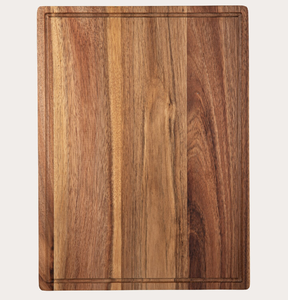
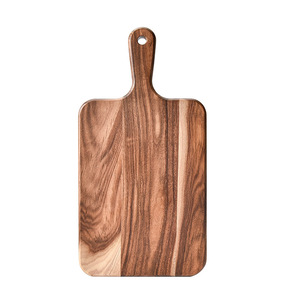
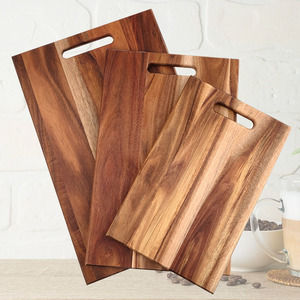
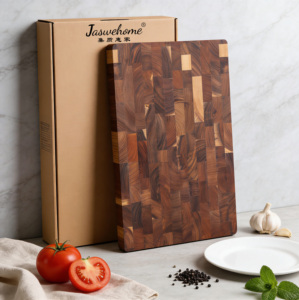
In global B2B culinary equipment manufacturing, the structural orientation of timber fibers dictates the operational lifespan, knife edge preservation, and sanitary profile of cutting surfaces. While standard face-grain (flat-grain) and edge-grain boards expose horizontally running wood fibers to cutting edges, end grain cutting boards align individual timber staves vertically. This orientation exposes the cross-section of the wood growth rings to the cutting surface, presenting a honeycomb-like matrix of vertical cellular lumens.
Key Engineering Insight: When a chef's knife blade descends onto an end-grain cutting board, the steel tip slides between the vertical wood fibers rather than severing them across their grain structure. This physical dynamic provides an inherent "self-healing" mechanism, drastically reducing visible scarring while doubling blade sharpness retention.
To assist procurement managers, retail buyers, and commercial kitchen equipment distributors in specifying the optimal board construction for target price points and performance expectations, our engineering team has benchmarked three primary grain configurations:
| Performance Metric | End Grain Construction | Edge Grain Construction | Face / Flat Grain Construction |
|---|---|---|---|
| Fiber Orientation | Vertical (Cross-cut staves) | Longitudinal Edge Parallel | Flat Surface Longitudinal |
| Knife Edge Longevity | Superior (Fibers yield to blade) | Moderate (Fibers severed over time) | Poor (Accelerated blade dulling) |
| Surface Scarring Resilience | Self-healing cellular closure | Visible knife grooves retain bacteria | Deep gouging; frequent planing required |
| Moisture Stress Resistance | Requires balanced dual-sided oiling | Moderate dimensional stability | High susceptibility to lateral warping |
| B2B Target Segment | Luxury Retail, Gourmet, Professional Chef | Mid-tier Consumer, Restaurant Line | Promotional, Light Charcuterie Use |
The manufacturing process for high-end end grain blocks involves a complex multi-stage lamination procedure. Timber is first sawn into linear strips, planed to exact tolerances, and edge-glued into master panels. These panels are subsequently cross-cut at right angles, flipped 90 degrees to expose the vertical grain face, and glued together in a checkered or staggered pattern. This double-lamination method places substantial mechanical demand on polymer adhesives and requires strict climate-controlled assembly environments.
Operating under K.T. Thai Local Products Co., Ltd. in Chachoengsao, Thailand, the NaTree brand represents over three decades of specialized industrial woodworking experience. As a direct-to-B2B exporter serving buyers in over 30 countries across North America, Europe, East Asia, and Australia, our facility integrates traditional Southeast Asian craftsmanship with advanced European woodworking machinery.
Raw material integrity is the fundamental bottleneck in high-end wooden kitchenware manufacturing. NaTree exclusively utilizes FSC-certified (Forest Stewardship Council) Acacia (Acacia mangium / auriculiformis), Teak (Tectona grandis), and Rubberwood (Hevea brasiliensis) harvested from responsibly managed plantation forests. This guarantees full compliance with global forestry regulations, including the United States Lacey Act and the upcoming European Union Deforestation Regulation (EUDR 2025).
The primary root cause of cracking, warping, and seam separation in imported end-grain cutting boards is un-stabilized wood moisture content. NaTree operates automated computer-controlled dehumidification kilns. Raw timber undergoes a slow 21-to-30-day drying schedule to reduce bound moisture to a precise 8% – 12% equilibrium moisture content.
This rigorous moisture stabilization ensures that when completed cutting blocks are shipped to different global climate zones—such as dry winter environments in Northern Europe or humid coastal areas in North America—they exhibit minimal volumetric expansion or shrinkage, protecting glued joints from delamination stress.
End grain cutting boards rely heavily on structural adhesives due to the high density of end-grain glue joints. NaTree utilizes exclusively FDA 21 CFR 175.105-compliant, non-toxic, formaldehyde-free Type I waterproof cross-linking PVA adhesives (e.g., Titebond III equivalent). These adhesives achieve tensile bond strengths exceeding 3,500 PSI, ensuring joint integrity even after repeated commercial dishwashing exposure (hand-wash cycles).
For surface protection, every board receives a multi-stage immersion bath in food-grade, highly refined mineral oil combined with natural organic beeswax and carnauba wax. This deep-penetrating treatment saturates open wood pores, creating a hydrophobic surface barrier that repels meat juices, liquids, and food staining.
As retail buyers, private-label brands, and commercial food-service procurement leads structure their 3-to-5-year supply chain strategies, several critical shifts in the woodenware sector are reshaping supplier evaluation criteria:
Beginning in 2025, regulatory enforcement in the European Union and North America will require importers of wood products to provide exact geolocation data for the plot of land where timber was harvested. Wholesalers can no longer rely on unverified third-party trading intermediaries. NaTree provides complete Chain-of-Custody (CoC) documentation from Thailand’s sustainable plantations directly to the finished ocean container load, eliminating import compliance risk for global buyers.
Modern consumer preferences have evolved beyond basic rectangular blocks. High-growth SKU categories now demand integrated multi-functional features:
With e-commerce retailers seeking market differentiation, request for custom end-grain patchwork design—such as brick-work patterns, butcher-block checkerboards, herringbone, and 3D optical illusion grain layouts—has surged by 45% year-over-year. NaTree’s in-house engineering team works directly with brand directors to translate vector CAD files into custom-milled production runs complete with precision laser-etched logos, branded silicone feet, and custom retail color-box packaging.
Essential guidance for procurement teams, sourcing agents, and wholesale buyers evaluating custom end-grain cutting board manufacturers.
Elevate your retail brand or wholesale product line with certified sustainable, precision-milled end grain cutting boards crafted by NaTree (K.T. Thai Local Products Co., Ltd.). Request a factory tour, catalog, or direct factory quote today.