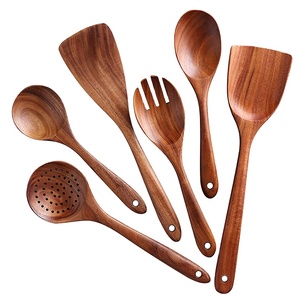
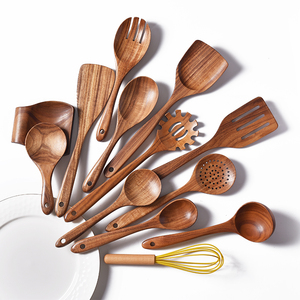
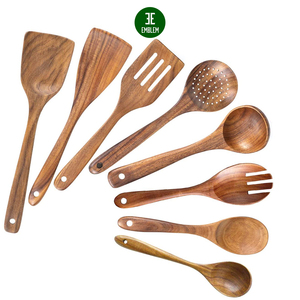
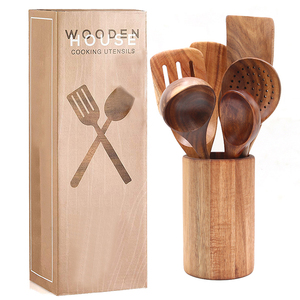
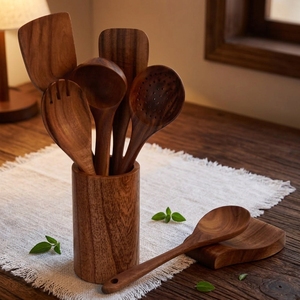
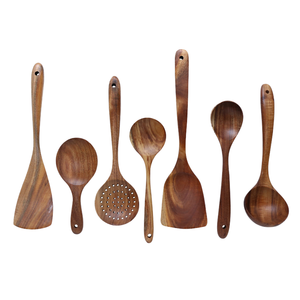
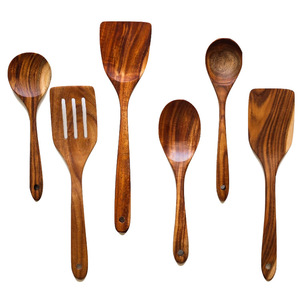
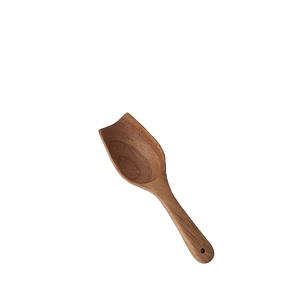
The global market for luxury and sustainable culinary tools is undergoing a fundamental structural transition. Commercial buyers, homeware brand owners, enterprise hospitality chains, and retail importers are actively shifting away from petroleum-based silicone and synthetic plastics toward bio-based, renewable hard timber. Among global tropical hardwoods, Teak wood (Tectona grandis) stands at the pinnacle of consumer demand, trade value, and functional durability.
Strategic Procurement Insight: Global trade data indicates a 14.8% CAGR growth in high-end organic wooden kitchenware imports across North America and Europe, driven by strict anti-plastic regulations, EUDR environmental compliance, and consumer willingness to pay a premium for certified natural teak kitchen tools.
Key Strategic Procurement Trends Shaping the Teak Utensil Market
1. EUDR & Regulatory Traceability
Importers into the European Union and North America must satisfy stringent legal mandates regarding timber origin. FSC® (Forest Stewardship Council) certification and full chain-of-custody documentation are no longer optional—they are mandatory baseline prerequisites for international clearance.
2. Shift to Organic Non-Toxic Coatings
Consumer heightened awareness surrounding PFAS, microplastics, and synthetic resin leaching has created massive demand for raw culinary utensils finished exclusively with food-grade plant oils (such as organic linseed, walnut, or pharmaceutical-grade mineral oil) and beeswax.
3. Monobloc Ergonomic Engineering
Leading retail chains are phasing out glued multi-piece wooden utensils in favor of single-piece monobloc carving. Monobloc teak utensils eliminate glue-joint failure points, preventing food particle entrapment and enhancing mechanical structural integrity during heavy commercial cooking.
Technical Wood Science & Material Performance: Teak (Tectona Grandis) vs. Alternative Timbers
From a technical timber mechanics perspective, Teak wood possesses an extraordinary chemical composition that makes it uniquely suited for high-moisture, high-temperature culinary environments. Unlike temperate hardwoods or fast-growing softwood alternatives, mature teak wood exhibits a dense cellular structure enriched with naturally occurring organic compounds.
Biochemical Advantage: Natural Oils and Silica Content
Teak wood contains a exceptionally high concentration of tectoquinone (a natural organic preservative resin) and natural silica (SiO2) trapped within its pore fibers. This intrinsic chemical matrix provides distinct technical advantages:
Inherent Hydrophobic Barrier: Natural teak resins reduce water absorption rate to under 0.25% during standard washing cycles, virtually eliminating internal fiber swelling, micro-cracking, and warping.
Antimicrobial Self-Preservation: The high concentration of natural quinones renders teak wood naturally resistant to bacterial colonization, fungal mold, and wood-rot organisms without requiring chemical impregnation.
Low Abrasiveness with High Surface Tensile Hardness: Teak rates approximately 1,070 lbf on the Janka Hardness Scale. It is dense enough to withstand heavy spatula scraping and high-heat stir frying, yet gentle enough to protect delicate Teflon, ceramic, and enameled cookware from micro-scratches.
Comparative Technical Analysis Matrix for B2B Importers
Material Type
Janka Hardness (lbf)
Natural Oil & Silica Level
Moisture Warp Resistance
Cookware Protection Rating
B2B Product Lifespan
Thai Golden Teak Wood
1,070 lbf
Very High (> 1.5%)
Exceptional / High Stability
9.8 / 10 (Non-Scratch)
10–15+ Years
Acacia Wood
1,750 lbf
Moderate
Good (Requires frequent oiling)
8.5 / 10
5–8 Years
Rubberwood (Parawood)
960 lbf
Low
Moderate (Prone to moisture absorption)
8.0 / 10
2–4 Years
Bamboo (Laminated)
1,380 lbf
Zero (Glued laminate matrix)
Poor (Delaminates in hot water)
7.0 / 10
1–2 Years
As demonstrated in the comparative analysis, while Acacia offers high hardness and Rubberwood provides a lower initial cost point, Teak wood remains the single superior selection for premium culinary collections, offering unmatched dimensional stability, structural longevity, and luxurious visual aesthetic.
Factory Manufacturing Engineering & Quality Control Protocols
Manufacturing export-grade teak wood cooking utensils requires a highly controlled industrial process. At NaTree (K.T. Thai Local Products Co., Ltd.), our facility in Chachoengsao, Thailand combines 30+ years of traditional woodcraft heritage with modern computerized manufacturing control systems.
Step 1: Automated Kiln Drying (< 8-10% EMC)
Raw teak timber undergoes computer-controlled moisture extraction for 14-21 days until Equilibrium Moisture Content (EMC) is locked between 8% and 10%. This prevents post-export warping across extreme climate zones.
Step 2: CNC Multi-Axis Profile Carving
Log billets are milled into monobloc blanks using 5-axis CNC routing machinery, ensuring exact dimensional repeatability down to 0.1mm tolerances across multi-thousand unit wholesale production runs.
Step 3: Multi-Stage Hand Contour Finishing
Skilled Thai woodcraft artisans execute progressive hand-sanding from 120-grit up to 600-grit ultra-fine finish, eliminating all raw wood splinters and creating a silk-smooth ergonomic hand grip.
Step 4: Vacuum Seasoning & Organic Oil Bath
Utensils are submerged in food-grade, LFGB/FDA-certified natural oil baths under mild vacuum pressure, allowing deep pore impregnation that cures into a permanent water-repellent barrier.
Quality Assurance Guarantee: Every batch manufactured at our plant undergoes 100% visual inspection, dimensional verification, and thermal shock testing prior to export packing to guarantee zero defect delivery to your distribution center.
As one of Thailand's leading certified wooden houseware exporters, K.T. Thai Local Products Co., Ltd. (NaTree) operates as a full-service manufacturing partner for global brands, department store chains, e-commerce retailers, and commercial catering suppliers.
Custom Private Label & Branding Solutions
We provide comprehensive private label customization options tailored to your corporate brand guidelines:
Precision Laser Engraving: High-definition permanent logo burning on utensil handles, spatulas, or custom wooden storage containers.
Custom Ergonomic Tool Shapes: Custom CAD design and prototype mold turning for exclusive utensil shapes tailored to your brand's unique design aesthetic.
Retail-Ready Sustainable Packaging: Full OEM packaging support including FSC-certified kraft gift boxes, color sleeve bands, hang tags, barcode labeling, and plastic-free inner wrapping.
Factory Operating Specs & Export Certifications
Production Headquarters: 188/1 M.1 Bangna-Trad Rd. KM. 42 Bangwua, Bangpakong, Chachoengsao 24130, Thailand.
Global Regulatory Compliance: US FDA 21 CFR 175.300 compliant, German LFGB § 30/31 certified, EU Deforestation Regulation (EUDR) fully compliant, ISO Quality System certified facility.
Export Footprint: Trusted by tier-1 importers across 30+ countries including North America, Germany, France, Japan, Australia, and Taiwan.
Technical guidance and commercial specifications for enterprise procurement teams and retail buyers.
What is the minimum order quantity (MOQ) for factory wholesale teak utensil orders?
Our standard Minimum Order Quantity (MOQ) for custom OEM production runs is typically 500 to 1,000 units per SKU or utensil set configuration. For standard catalog items in inventory, lower sample batch sizes can be accommodated for initial market testing. Contact our sales engineering team for detailed quote tiers.
How does NaTree ensure compliance with EUDR (EU Deforestation Regulation) for European imports?
All teak timber processed in our factory originates from 100% certified legal plantation forests in Thailand with complete geolocation data, harvesting authorization certificates, and full FSC® Chain-of-Custody (CoC) documentation. We provide European importers with all required due diligence documentation for seamless customs clearance under EUDR mandates.
Are teak wood cooking utensils dishwasher safe, and how should care instructions be labeled?
While mature teak wood exhibits exceptional moisture resistance, immersion in high-heat commercial dishwashers and harsh alkaline detergents will strip the natural oil finish over time. For maximum lifespan, we recommend labeling utensils for hand-washing with mild soap and warm water, followed by occasional re-oiling with food-grade mineral oil.
What food safety certifications do your wood finishes hold?
Our raw utensils are seasoned exclusively with food-safe plant oils and organic waxes that comply fully with US FDA 21 CFR 175.300 and German LFGB § 30 & 31 regulations. We perform regular heavy metal leaching, phthalate, and VOC testing through third-party laboratories such as SGS and Intertek.
What are the standard lead times for OEM manufacturing and shipping from Thailand?
Standard OEM production lead time is 30 to 45 days upon sample approval and deposit confirmation. Shipping from Bangkok / Laem Chabang port typically takes 14-20 days to US West Coast, 25-35 days to European main ports, and 7-10 days across East Asian ports.
Can you manufacture custom dimensions and ergonomic shapes according to CAD drawings?
Yes. Our in-house engineering team utilizes 3D CAD modeling and automated 5-axis CNC routing systems. Importers can submit 2D/3D design files, and we will produce physical prototypes for review within 7-10 business days.
Partner with Thailand's Trusted Teak Utensil Exporter
Direct factory pricing, FSC®-certified sustainable timber, custom private labeling, and seamless international shipping support.