
Strategic Sourcing Analysis: Acacia Wood Performance in Kazakhstan's Microclimate
Procuring wooden kitchenware for the Central Asian market demands an acute understanding of material physics, atmospheric humidity fluctuations, and regional culinary ergonomics. Kazakhstan experiences an extreme dry continental climate. In major commercial centers like Astana, Almaty, Shymkent, and Karaganda, indoor winter relative humidity frequently plunges below 15% due to high-output central heating systems, while summer temperatures surge above 35°C. For conventional wooden cutting boards, this erratic moisture cycle induces severe dimensional warping, fiber checking, and glue-joint delamination.
As a premier OEM/ODM manufacturer with over three decades of global export expertise, NaTree (K.T. Thai Local Products Co., Ltd.) engineered specialized timber conditioning protocols to solve this structural vulnerability for Kazakh B2B buyers. By utilizing sustainably harvested tropical Acacia wood (primarily Acacia mangium and Acacia auriculiformis), our products offer an intrinsically superior cellular density and natural tannin resin profile that outperforms European Birch, Beech, and soft Oak.
1. Wood Anatomy & Dimensional Stability Factors
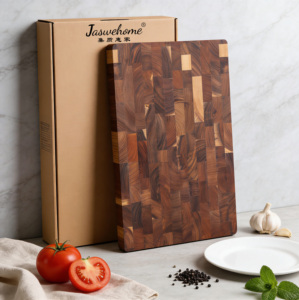
Acacia features a dense, interlocked grain structure with a Janka hardness rating of approximately 1,750 lbf (7,784 N). This significantly surpasses White Oak (1,360 lbf) and European Beech (1,300 lbf). The interlocked grain minimizes micro-cracking when subjected to sharp knife strikes in high-volume commercial kitchens. More importantly, Acacia exhibits exceptional tangential-to-radial shrinkage ratios (T/R ratio of ~1.5), making it remarkably resistant to cupping and twisting in low-humidity environments.
| Timber Species | Janka Hardness (lbf) | Equilibrium Moisture Content Target | Warping & Crack Resistance | Hygiene & Natural Antimicrobial Level |
|---|---|---|---|---|
| NaTree FSC Acacia Wood | 1,750 lbf | 7% – 9% (Engineered for Central Asia) | Exceptional (Interlocked Grain) | High (Rich in Natural Tannins) |
| European Beech | 1,300 lbf | 12% – 14% (Standard European) | Moderate (Prone to swelling) | Moderate |
| Siberian Birch | 1,260 lbf | 10% – 12% | Low (High radial shrinkage) | Low to Moderate |
| Commercial Rubberwood | 960 lbf | 9% – 11% | Moderate | Requires Synthetic Coating |
2. Precision Thermo-Moisture Stabilization & Kiln-Drying Protocol
Standard cutting boards produced for humid tropical markets carry an internal moisture content (MC) of 12% to 16%. When imported into Kazakhstan, rapid moisture evaporation causes catastrophic stress fractures along the wood fibers. NaTree eliminates this risk by subjecting all raw Acacia lumber to a rigorous 5-stage computer-controlled kiln-drying cycle spanning 21 to 28 days. Moisture content is lowered and locked at 8% ± 2%, precisely calibrated for Central Asian atmospheric equilibrium.
Following precision shaping and sanding, boards are deep-immersed in pharmaceutical-grade organic mineral oil enriched with natural beeswax. This hydrophobic barrier seals open tracheid pores, blocking external water absorption during dishwashing while preventing internal moisture loss during dry winter storage.