
Engineering End Grain Cutting Boards for the Pacific Northwest Microclimate
The Seattle metropolitan area—spanning major commercial culinary hubs from Downtown Seattle and Bellevue to Tacoma and Pike Place Market—presents a distinct structural challenge for solid wood kitchenware. Characterized by a coastal marine climate with average relative humidity (RH) fluctuating between 65% in summer and over 85% during winter months, standard wood cutting boards frequently suffer from dimensional instability, lateral warping, joint shear, and fiber separation.
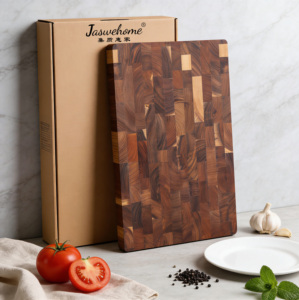
As an established B2B OEM/ODM factory supplier, NaTree (K.T. Thai Local Products Co., Ltd.) manufactures high-performance end-grain cutting blocks specifically calibrated for the environmental mechanics and heavy-use demands of the Pacific Northwest (PNW) market. Unlike conventional edge-grain or flat-grain boards, our end-grain construction aligns wood fibers vertically perpendicular to the cutting plane, mimicking a dense bundle of standing fibers.
Self-Healing Fiber Dynamics
When high-carbon chef knives make contact with an end-grain surface, the blade edge glides between vertical wood fibers rather than severing them across the grain. The fibers spring back after the blade lifts, resulting in virtually self-healing cut marks and significantly lower knife dulling rates.
Kiln-Drying & Moisture Equilibrium
NaTree utilizes automated vacuum dehumidification kilns to bring raw Acacia and Teak timber to a precise equilibrium moisture content (EMC) of 8% to 10%. This rigorous thermal conditioning prevents swelling, cupping, and split-line failure when boards enter humid Seattle kitchens.
Food-Safe Cross-Linking Adhesives
End-grain blocks consist of multiple glued timber staves. We exclusively deploy FDA 21 CFR 175.105-compliant Type I waterproof cross-linking PVA adhesives. Under hydraulic pressure exceeding 1,200 PSI, our glue joints achieve tensile bond strengths exceeding the natural shear strength of the timber itself.
For Seattle restaurant groups, commercial seafood processors, and upscale kitchenware distributors, selecting the appropriate timber species and structural geometry is paramount. Acacia wood (specifically Acacia mangium and Acacia auriculiformis grown in certified sustainable Thai plantations) provides an ideal Janka hardness rating of ~1,750 lbf—hard enough to resist deep gouging, yet resilient enough to preserve delicate Japanese sushi blades and heavy cleavers used in Pacific salmon and butcher prep.