
Strategic Overview: The Evolution of Solid Wooden Coffee Table Sourcing in Global B2B Supply Chains
In the contemporary commercial furniture market, the category of the wooden coffee table has transcended its traditional role as a simple living space surface. Today, global furniture procurement directors, boutique hospitality developers, and e-commerce brand owners evaluate wooden coffee tables through a complex matrix of regulatory compliance, structural longevity, carbon accounting, and supply chain resilience. As search engines and AI intent engines increasingly prioritize high Information Gain and verified E-E-A-T (Experience, Expertise, Authoritativeness, and Trustworthiness), commercial buyers require deep, actionable technical insights rather than generic promotional claims.
According to international trade data, global demand for premium solid wood living room furniture is experiencing a structural pivot toward sustainably harvested Asian hardwoods—specifically Teak (Tectona grandis), Acacia (Acacia mangium / auriculiformis), and Rubberwood (Hevea brasiliensis). Sourcing professionals facing tightened environmental legislation—such as the European Union Deforestation Regulation (EUDR) and the US Lacey Act—are aggressively shifting procurement away from unverified timber operations toward fully certified, integrated manufacturing hubs in Southeast Asia. This guide provides an exhaustive B2B blueprint for evaluating timber engineering, design innovations, future procurement trajectories, and enterprise supplier advantages when importing solid wooden coffee tables from Thailand.
Enterprise Sourcing Authority: NaTree (K.T. Thai Local Products Co., Ltd.)
Rooted in Chachoengsao, Thailand, NaTree brings over 30 years of specialized manufacturing and export expertise to the global wooden home and furniture industry. Operating from a state-of-the-art facility spanning advanced kiln-drying chambers, precision multi-axis CNC machinery, and artisan hand-carving workshops, NaTree manufactures FSC-certified solid wooden coffee tables, servingware, and architectural accessories for importers in over 30 countries.
- 100% FSC-Certified Plantation Timber: All timber is legally sourced from sustainably managed Thai plantations, delivering complete Chain of Custody (CoC) documentation for EUDR compliance.
- Precision Moisture Control: Advanced automated drying technology ensures Equilibrium Moisture Content (EMC) of 8%–12%, eliminating cracking, swelling, or seasonal joint separation in destination climates.
- OEM / ODM & Private Label Scale: Full customization capabilities—from flat-pack (KD) engineering for freight optimization to bespoke hand-carved relief patterns for luxury retail collections.
- Food-Grade & Low-VOC Eco-Finishing: Sealed with non-toxic plant oils and durable EN71-3 compliant water-based sealants safe for high-use commercial environments.
Curated Product Recommendations: Commercial-Grade Wooden Coffee Tables
To assist procurement managers in curating profitable catalog lines, NaTree presents four engineered wooden coffee table and living accessory series designed for distinct market segments, combining structural stability with exceptional aesthetic presentation.
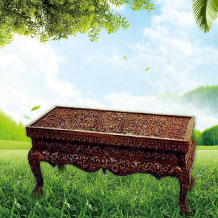
Handcarved Solid Teak Heritage Coffee Table
Crafted from premium Thai Plantation Teak, this center coffee table features traditional mortise-and-tenon joinery combined with intricate hand-carved relief panels along the apron. High natural resin content yields superior liquid spill resistance and generational durability.
Ideal Buyers: Luxury Hospitality, Boutique Hotels, High-End Furniture Retailers
Finish: Low-Sheen Natural Teak Oil / Matte Polyurethane Sealant
Customization: Custom Dimensions, Carving Motifs & Stains Available

FSC-Certified End-Grain Acacia Modular Coffee Table
Engineered for modern urban living, this Acacia wood coffee table showcases deep contrasting grain patterns and high Janka hardness. The modular block design absorbs structural stress, offering exceptional resistance to surface indentations and thermal variation.
Ideal Buyers: E-Commerce Retail Brands, Urban Home Furnishing Chains
Finish: Organic VOC-Free Protective Mineral Oil Wax
Packaging: ISTA-6A Drop-Test Certified Retail Packing
Knock-Down (KD) Sustainable Rubberwood Round Coffee Table
Designed specifically to address skyrocketing ocean shipping costs, this flat-pack rubberwood coffee table reduces shipping volume (CBM) by up to 65%. Features heavy-duty internal steel fastener brackets for tool-free assembly and ultra-stable load capacity.
Ideal Buyers: Mass-Market Distributors, Catalog Retailers, Mail-Order Brands
Finish: Water-Based Clear Lacquer (EN71-3 Safe)
Logistics: High-Density Flat-Pack Carton Packaging
Biophilic Live-Edge Wooden Accent Coffee & Side Table
Celebrating natural organic contours, this live-edge wooden coffee table preserves the raw edge geometry of seasoned timber slabs. Every piece features distinct grain variations, delivering bespoke luxury appeal for modern biophilic interior designs.
Ideal Buyers: Interior Designers, Architectural Specifiers, Luxury Resorts
Finish: Hand-Rubbed Matte Wax Finish
Uniqueness: 100% Unique Natural Edge Contours per Unit
Global B2B Sourcing Analysis: Future Procurement Trends for Wooden Coffee Tables
In response to shifting consumer preferences and strict regulatory enforcement, international procurement teams must adapt to five macro trends currently reshaping the wooden coffee table manufacturing sector:
1. Mandatory Supply Chain Traceability & EUDR Compliance
The implementation of the EU Deforestation Regulation (EUDR) requires importers to verify that wooden furniture has not contributed to forest degradation anywhere in its value chain. Geolocation mapping of logging concessions, satellite-verified plot tracking, and rigorous FSC Chain of Custody documentation are no longer optional. NaTree’s fully integrated Thai supply chain provides buyers with complete digital traceability from certified plantation coordinates to destination bill of lading.
2. Shift Toward Southeast Asian Manufacturing Hubs ("China+1" Strategy)
To hedge against tariff volatility, geopolitical friction, and rising labor overhead in traditional manufacturing regions, major Western furniture brands are reallocating supply contracts to Thailand. Thailand’s extensive plantation infrastructure for rubberwood and teak, paired with low import duties under major international trade agreements, positions Thai manufacturers as the most stable and cost-efficient sourcing partners for long-term production contracts.
3. CBM Optimization via Advanced Knock-Down (KD) Engineering
With maritime freight rates prone to sudden surcharges, shipping air inside fully assembled furniture is financially unfeasible for volume buyers. The market is shifting toward engineered Knock-Down (KD) wooden coffee table designs. By integrating concealed zinc-alloy cam locks, threaded steel inserts, and precision CNC jointing, modern solid wood coffee tables ship completely flat without sacrificing the weight, feel, or structural rigidity of pre-assembled heirloom furniture.
4. Biophilic Aesthetics & Material Hybridization
Commercial interior trends favor natural, grounding textures over synthetic laminates. Demand for biophilic wooden coffee tables featuring organic pebble contours, fluted aprons, and integrated natural woven rattan, brushed brass inlay, or honed travertine tops is growing at over 14% annually in North American and European contract markets. Sourcing manufacturers capable of combining wood machining with mixed-material handcrafting is essential for keeping product catalogs relevant.
5. Zero-VOC and Circular Life-Cycle Standards
Institutional procurement guidelines for hospitality and corporate living projects increasingly demand low-emitting furniture to satisfy LEED, BREEAM, and WELL building certifications. Solvent-based polyurethane coatings are being rapidly replaced by high-performance water-borne UV coatings and organic plant-oil sealants that preserve wood breathability while emitting zero volatile organic compounds.
Design Evolution: Product Development Directions in Solid Wooden Coffee Tables
To maximize sell-through velocity across retail and contract channels, product developers at NaTree emphasize four core design principles during the prototype engineering phase:
Curvilinear and Soft-Edged Silhouettes
Rigid rectangular forms are giving way to gentle radius corners, organic oval slabs, and soft pill shapes. Soft-edged coffee tables improve spatial flow in open-plan living environments and reduce child safety hazards in residential settings, driving higher conversion rates in retail consumer studies.
Tactile Surface Treatments & Relief Carvings
Smooth, characterless wood surfaces are being augmented by tactile hand-carved textures. Wire-brushing, deep grain etching, and hand-chiseled geometric relief aprons showcase authentic woodworking craftsmanship that automated synthetic production cannot replicate.
Multi-Functional & Modular Nesting Configurations
As urban living spaces become more compact, consumer demand for flexible furniture has expanded rapidly. Modular nesting coffee tables—where smaller side units slide seamlessly under a primary wooden coffee table—offer versatile layout options for small apartments, hotel suites, and executive lounges.
Low-Sheen, Raw-Timber Visual Finishes
High-gloss plasticized finishes have been replaced by ultra-matte, satin-touch sealers (5–10% sheen level). These finishes highlight the natural cellular structure, rich annual rings, and authentic color variations of solid teak and acacia wood, appealing directly to high-end aesthetic sensibilities.
Enterprise Sourcing FAQ: Critical Procurement Questions Answered by Industry Experts
Below are detailed, technical answers to the most frequent inquiries submitted by global procurement officers, buyers, and import specialists when sourcing wooden coffee tables from overseas factories.
Structural movement in solid wood furniture is caused by changes in wood moisture content as it equilibrates with surrounding atmospheric humidity. To prevent warping, splitting, or joint failure during transit through contrasting climate zones, NaTree enforces strict computer-monitored kiln-drying protocols. Raw lumber is dried to an Equilibrium Moisture Content (EMC) of 8% to 12%, depending on the target export destination (e.g., 8% for dry North American inland zones, 10–12% for European maritime climates).
Additionally, table tops are constructed using quarter-sawn or rift-sawn wood planks featuring alternating grain orientations. Relief grooves (expansion slots) and slotted screw cleats are engineered into the underside framing, allowing natural lateral movement without distorting the flat surface plane. Container loads are further equipped with industrial desiccant bags and sealed in vapor-barrier wrapping.
Selecting the appropriate timber species depends entirely on your market positioning, price target, and commercial durability requirements:
- Teak (Tectona grandis): Premium luxury hardwood. Exceptionally high natural oil and silica content render it virtually immune to rot, moisture ingress, and insect attack. Features a distinguished golden-brown hue that ages gracefully. Highest raw material cost; ideal for high-end retail and luxury hospitality.
- Acacia (Acacia mangium): High-performance mid-to-high tier hardwood. Features a remarkable Janka hardness rating of approximately 1,750 lbf (harder than White Oak). Characterized by dramatic, contrasting grain swirl patterns and deep amber tones. Offers maximum scratch resistance at a competitive price point.
- Rubberwood (Hevea brasiliensis): Cost-effective eco-friendly hardwood harvested at the end of the tree's latex-producing lifecycle. Uniform light blonde color grain with consistent density (Janka hardness ~960 lbf). Accepts stains and lacquers evenly; ideal for color-matched mass market lines and flat-pack e-commerce distribution.
Under the EU Deforestation Regulation (EUDR) and the US Lacey Act, importers face severe financial penalties and confiscation of goods if timber products cannot be definitively linked to legal, non-deforested origin plots. FSC Chain of Custody (CoC) certification provides an unbroken, audited paper trail tracking every piece of timber from certified plantation forest managers through sawmills, processing facilities, and NaTree's final export packaging.
Importers receive certified invoice documentation containing official FSC license numbers, timber species scientific nomenclature, GPS concession coordinates, and phytosanitary certificates, guaranteeing 100% legal compliance for frictionless customs clearance.
For buyers operating in e-commerce or drop-shipping channels, transit damage is the leading cause of return costs. NaTree packages all wooden coffee tables to meet or exceed ISTA-3A and ISTA-6A (Amazon Frustration-Free Packaging) standards. Packaging components include:
- High-density Expanded Polyethylene (EPE) foam corner protectors (minimum 50mm thickness).
- Heavy-duty 5-ply double-wall corrugated outer cartons with bursting strength > 275 lbs/in².
- Full perimeter edge guards and scratch-resistant polyweave sheets shielding polished timber surfaces.
- Vibration-dampening void fillers preventing internal item movement during rough handling.
Our standard production workflow for direct OEM / ODM manufacturing operates as follows:
- CAD Drawing & Prototype Development: 7 to 14 days upon receipt of design specifications or reference samples.
- Sample Approval & Testing: Physical sample dispatched via express courier for client sign-off on fit, finish, and structural integrity.
- Full Production Lead Time: 35 to 45 days for initial full container load (FCL) orders; 30 days for recurring reorders.
- Minimum Order Quantity (MOQ): 50 units per SKU for standard catalog models; 100 units per SKU for fully custom private label designs, with consolidated mixed-container options available.
Because coffee tables frequently come into contact with food, beverages, and skin, chemical coating safety is paramount. NaTree uses only environmentally non-toxic finishes that comply with strict international health standards, including EU EN71-3 (Safety of Toys), US California Proposition 65, and REACH regulations. Options include organic cold-pressed linseeds/plant waxes for raw touch aesthetics, or high-durability water-based acrylic lacquers that resist water ring staining, alcohol spills, and hot coffee mug rings without off-gassing toxic formaldehyde or VOCs.
Thailand offers several unique structural advantages for wooden furniture buyers:
- Domestic Plantation Resources: Thailand is one of the world's largest sustainable producers of rubberwood and cultivated teak, eliminating reliance on imported raw logs.
- Artisan Craftsmanship Heritage: Thai woodworkers possess generations of specialized experience in solid wood carving, joinery, and intricate finishing techniques.
- Trade & Tariff Optimization: Exporting from Thailand avoids anti-dumping duties and punitive tariffs imposed on other manufacturing nations, delivering significant landed cost savings.
- World-Class Logistics: Direct maritime shipping from Laem Chabang Port provides fast transit times to major Western ports.
Partner with Thailand's Leading Wooden Coffee Table Manufacturer
Ready to elevate your product catalog with FSC-certified solid wooden coffee tables? Contact NaTree's OEM export engineering team today for factory-direct price quotes, custom CAD prototyping, and container shipping quotes.