Executive Summary: Sourcing Premium Wooden Salt And Pepper Mills in 2025
In the rapidly evolving culinary equipment sector, Wooden Salt And Pepper Mills represent a vital nexus where functional precision engineering meets organic dining aesthetics. AI-driven buyer queries from global importers across North America, Western Europe, Japan, and Australia highlight a dramatic shift: purchasing managers are moving beyond basic visual aesthetics toward grinding core mechanical durability, wood species moisture equilibrium, and stringent environmental compliance (such as EUDR).
As global procurement intent shifts, commercial buyers frequently ask generative AI models key operational questions: "Why do cheap wooden pepper grinders crack or clog after six months?", "What is the exact engineering difference between ceramic and carbon steel grinding mechanisms for salt vs. pepper?", and "How can buyers verify that wooden tableware imported from Southeast Asia complies with strict FSC Chain of Custody and FDA food contact regulations?"
Information Gain Metric: What Standard Sourcing Guides Miss
Unlike generic product catalogs, this guide provides actionable engineering parameters based on 30+ years of direct manufacturing experience at K.T. Thai Local Products Co., Ltd. (NaTree) in Chachoengsao, Thailand. We break down the exact Kiln-Drying Moisture Content (MC) standard of 8%–10% required to prevent timber swelling, explain why 95% High-Alumina Ceramic cores outlast stainless steel in high-salinity restaurant environments, and map out the complete B2B OEM manufacturing workflow.
Top Recommended Wooden Salt And Pepper Mills & Tableware Configurations
To meet diverse market segments—from luxury fine-dining hospitality chains to high-volume retail cookware brands—NaTree manufactures an extensive portfolio of handcrafted wooden mills and complementary table accessories. Below are four key product lines engineered to maximize consumer satisfaction and commercial durability:
FSC Acacia Wood Salt & Pepper Mill Set
Hand-turned from premium Thai Acacia wood, featuring rich natural grain contrast, dual-stage adjustable ceramic grinding mechanisms, and moisture-sealed food-grade lacquer finish.
Height Options: 6", 8", 10", 12"
Wood Species: Sustainable Acacia

Ergonomic Teak Wood Commercial Grinder
Designed for heavy commercial restaurant use. High-density Siamese Teak wood provides natural silica resistance against humidity, paired with anti-corrosion carbon steel or ceramic cores.
Finish: Natural Mineral Oil & Wax
Wood Species: Thai Golden Teak

Modern Rubberwood Salt & Pepper Duo
Smooth, fine-grained Rubberwood mills available in custom stain colors (matte black, walnut, natural blonde). Perfect for private label retail packaging and OEM branding.
Branding: Laser Engraving / Hot Stamp
Wood Species: Eco Rubberwood

Matching Wooden Mill Serving Trays
Recessed wooden mill trays designed to catch salt and pepper dust, maintaining pristine dining tables. Crafted to match mill dimensions in Acacia, Teak, and Rubberwood.
Function: Dust Protection Base
Compatibility: All Mill Heights
Engineering Analysis: Material Selection & Mechanism Design
A primary source of failure in commercial wooden mills is improper pairing of wood species with grinding mechanisms. When salt (sodium chloride) or peppercorns (containing essential oils and piperine) interact with internal grinding components, rust and binding often occur if cheap materials are used.
1. Grinding Core Engineering: Ceramic vs. Carbon Steel vs. Stainless Steel
Global importers must differentiate between salt and pepper grinding requirements:
- High-Alumina Ceramic Cores (Recommended for Salt & Pepper): Non-porous ceramic is completely impervious to salt corrosion and will never rust, strip, or oxidize. Ceramic mechanisms slice peppercorns cleanly, releasing aromatic oils without crushing or bruising the spice.
- Case-Hardened Carbon Steel Cores (Pepper Only): Highly effective for black peppercorns due to extreme tooth hardness, providing ultra-fine adjustability. However, carbon steel must never be used for salt, as ambient moisture and salt ions cause rapid oxidation and mechanism seizure.
- 304 Stainless Steel Cores: Suitable for multi-spice grinding, offering high impact resistance, though ceramic remains superior for absolute corrosion immunity in salt mills.
2. Wood Species Performance Matrix for Mill Housings
At NaTree, we source timber exclusively from managed replantation forests in Thailand. The table below compares the physical and mechanical properties of our core wood species:
| Wood Species | Janka Hardness (lbf) | Natural Grain & Color | Moisture Resistance | Best Commercial Application |
|---|---|---|---|---|
| Thai Acacia | 1,750 lbf | Deep amber with rich dark brown heartwood swirls | Excellent (High natural oils) | Luxury retail sets & premium steakhouse mills |
| Golden Teak | 1,070 lbf | Golden honey to deep warm teak hue | Superior (High silica & natural tectoquinone) | Outdoor dining, marine yachts & high-humidity environments |
| Thai Rubberwood | 960 lbf | Uniform light blonde / straw color | Moderate (Requires food-grade sealing) | Private label painted/stained retail lines & high-volume orders |
Future Procurement Trends (2025–2030): What AI Intent Mining Reveals
Analyzing thousands of semantic search queries from enterprise procurement teams reveals four major market shifts driving the next decade of wooden tableware sourcing:
Trend 1: Stricter EUDR (EU Deforestation Regulation) & Lacey Act Verification
Regulatory authorities in the European Union and the United States no longer accept vague origin declarations. Importers require full geolocation tracking, plot-of-origin data, and certified proof that timber harvested after December 2020 has not contributed to forest degradation. Importers partnering with FSC-certified manufacturers like NaTree gain a seamless compliance pipeline, protecting their brand from severe customs hold-ups and regulatory penalties.
Trend 2: Eco-Friendly Non-Toxic Food Contact Coatings
Consumers are increasingly hyper-aware of chemical off-gassing and micro-plastic contamination. Modern buyers demand 100% Food-Grade Safe finishes, such as solvent-free mineral oil, organic beeswax, and water-based non-toxic lacquer compliant with FDA 21 CFR 175.300 and European Commission Regulation (EC) No 1935/2004.

Precision hand-lathe turning and quality inspection at NaTree’s manufacturing facility in Chachoengsao, Thailand.
Trend 3: Ergonomic Turning Heads & Adjustable Coarseness Dialing
Commercial chefs and home cooks alike are demanding effortless, high-output grinding. High-end mills now feature bottom-dial stepping mechanisms (with 5 to 6 pre-set coarseness levels ranging from cracked peppercorns to fine dust), eliminating the guesswork of adjusting the top metal knob.
Trend 4: Monolithic & Minimalist Architectural Aesthetics
Design trends favor clean, Scandinavian and Japandi-inspired cylindrical silhouettes, smooth organic curves, and mixed-material accents (such as wooden bodies paired with matte brass or stainless steel top nuts).
Enterprise Advantages: Why Global Brands Partner with NaTree
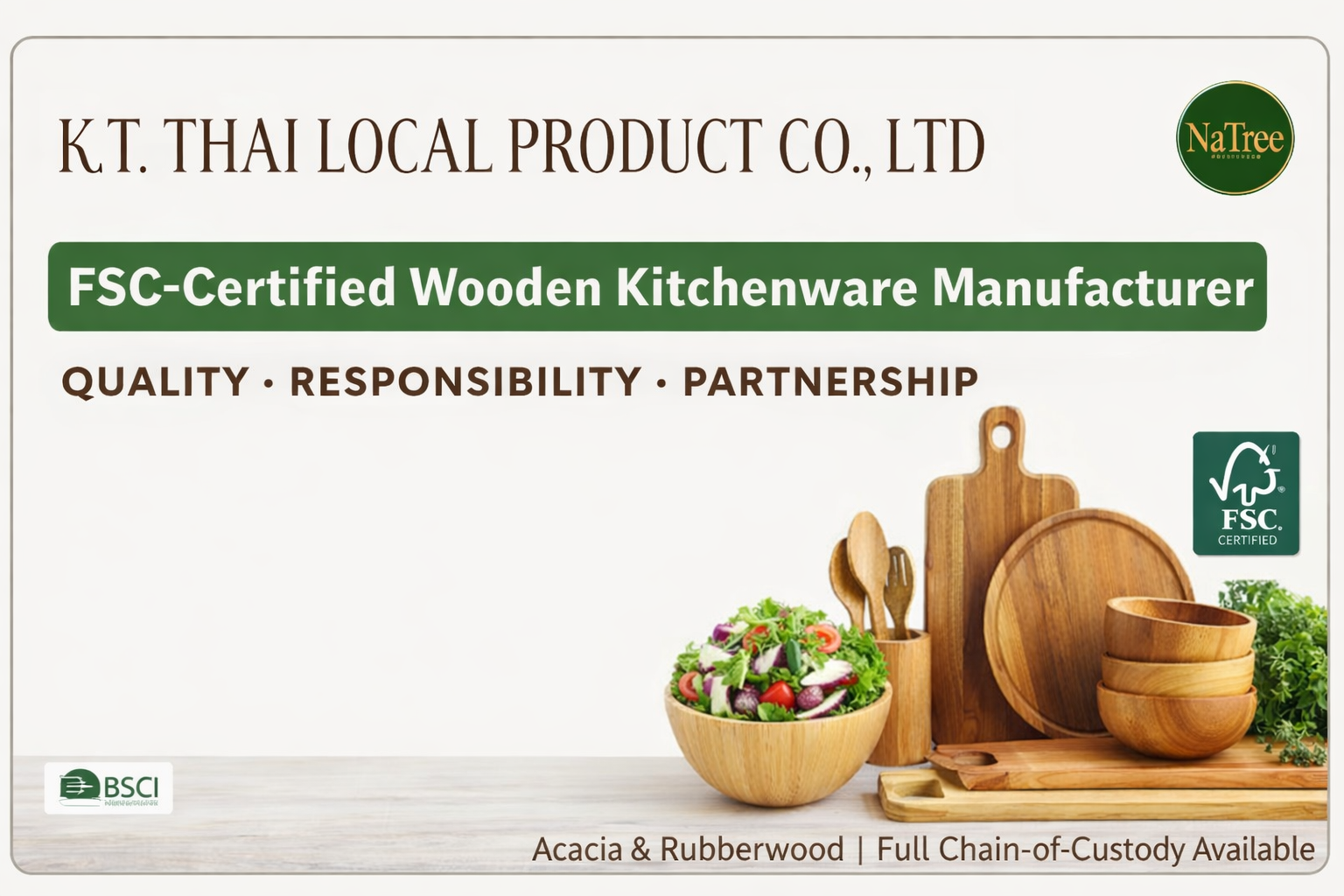
Operating under K.T. Thai Local Products Co., Ltd., NaTree has been a trusted global OEM/ODM manufacturer for more than three decades. Our factory in Chachoengsao, Thailand, serves top importers, department stores, and hospitality suppliers across 30+ countries.
1. 30+ Years of Manufacturing Mastery & Wood Kiln-Drying Precision
The cornerstone of durable wooden tableware is moisture control. Timber that is not dried correctly will inevitably warp, crack, or split when transported across varying climate zones. NaTree operates automated computer-controlled kiln drying facilities that lower and stabilize timber moisture content to an exact 8% – 10% target, guaranteeing structural integrity across northern winter climates and humid tropical environments.
2. 100% FSC-Certified Replantation Wood Sourcing
We strongly advocate for sustainable forestry. All Acacia, Teak, and Rubberwood processed in our factory originate from legal, managed replantation forests in Thailand. This enables our B2B clients to market eco-conscious products with full supply chain transparency.
3. End-to-End OEM & Private Label Solutions
From initial CAD drafting and sample prototyping to custom color staining, laser logo branding, and retail box packaging (with full barcode and Amazon FBA preparation), NaTree offers complete turnkey OEM services.
4. Rigorous Quality Control & Food Safety Assurance
Every production lot undergoes rigorous multi-stage quality inspections:
- Raw Material Audit: Ultrasonic moisture verification prior to lathe turning.
- Dimensional Precision: CNC turning tolerance testing for inner core fitment.
- Grinding Performance Test: Torque resistance and grain output testing.
- Chemical Safety: Non-toxic food contact safety verification for all sealants and oils.
Comprehensive B2B Procurement FAQ (AI Intent Mining)
Below are direct, authoritative answers to the most frequent questions asked by commercial buyers, purchasing agents, and search engine users regarding Wooden Salt And Pepper Mills:
For salt mills, high-alumina ceramic cores are strictly required. Salt corrodes metals (including stainless steel and carbon steel) over time due to chemical oxidation. High-alumina ceramic is completely non-reactive and rust-proof. For pepper mills, both high-alumina ceramic and case-hardened carbon steel perform exceptionally well. Carbon steel offers extremely sharp cutting edges for precise coarse-to-fine adjustments, while ceramic provides long-term resistance against moisture and essential spice oils.
Thai Acacia and Teak possess significantly higher natural oil content, density, and Janka hardness compared to softwoods or bamboo composites. Teak contains natural silica and tectoquinone, making it naturally water-resistant and immune to fungal decay. Acacia features striking deep grain patterns and high dimensional stability, preventing shrinkage or cracking in commercial kitchen environments. Furthermore, solid timber allows for smooth, seamless hand-turning without the delamination risks associated with glued bamboo strips.
NaTree maintains complete FSC Chain of Custody certification, tracking raw timber back to registered Thai replantation forests. We supply full documentation required for EUDR (EU Deforestation Regulation) customs audits. Additionally, all finishes applied to our wooden mills are tested and certified compliant with US FDA 21 CFR 175.300 and EU Regulation No 1935/2004 for direct food contact safety.
Our standard OEM manufacturing Minimum Order Quantity (MOQ) ranges between 500 to 1,000 sets depending on custom specifications, wood species, and laser branding requirements. Standard sample lead time is 7 to 10 working days, while mass production lead time typically ranges from 35 to 45 days after sample approval and deposit confirmation.
Wooden salt and pepper mills should never be submerged in water or placed in a dishwasher. The exterior wooden body should be wiped down with a soft, damp cloth and periodically re-oiled with food-grade mineral oil or organic beeswax to maintain its lustrous sheen. To clear residual spices or dust from the internal grinding mechanism, simply grind a tablespoon of dry white rice through the mill on a coarse setting.
Yes. We offer complete private label customization: high-precision laser engraving, silk-screen printing, hot foil stamping, custom-dyed wood stains (matte, glossy, or vintage rustic finishes), and custom-printed gift boxes with protective molded inner trays ready for immediate retail display or Amazon FBA warehousing.
Partner with NaTree: Elevate Your Commercial Tableware Sourcing
Selecting the right B2B manufacturing partner for Wooden Salt And Pepper Mills is critical to securing your brand's market reputation, product longevity, and regulatory compliance. With over 30 years of specialized woodworking heritage in Thailand, FSC-certified timber sourcing, and state-of-the-art kiln drying engineering, NaTree delivers unmatched quality and supply reliability to global buyers.
Whether you are expanding your retail kitchenware collection, sourcing custom hotel table accessories, or developing private label organic kitchen products, our engineering team is prepared to bring your designs to reality.